
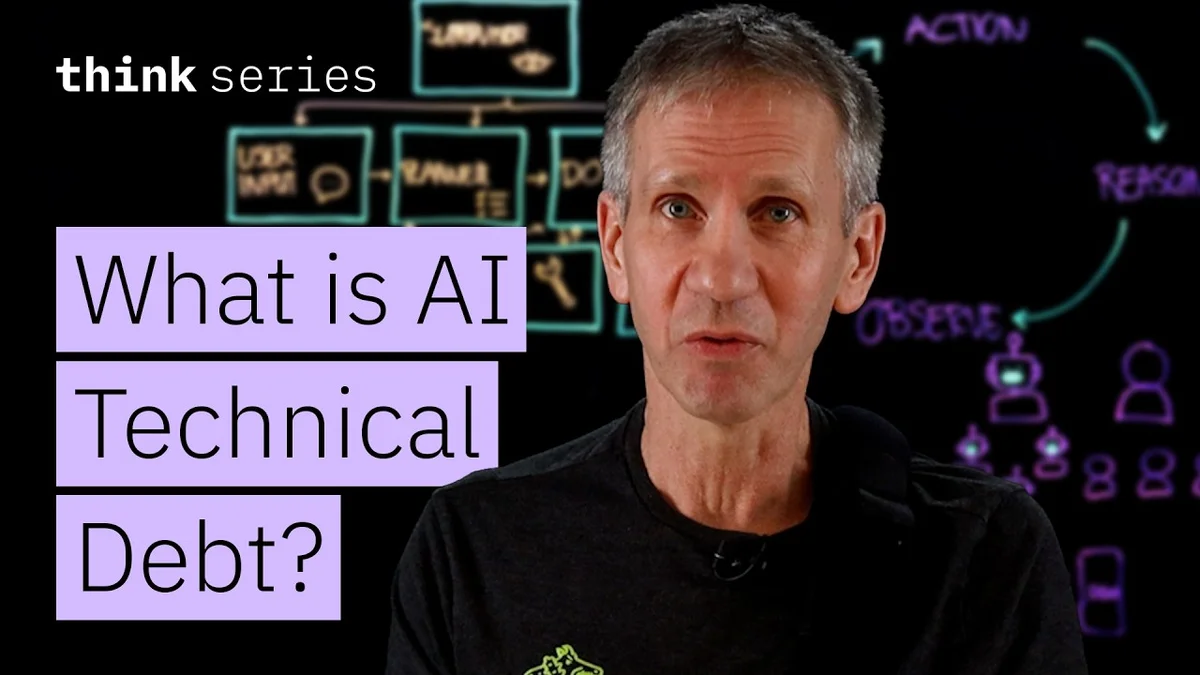
Jeff Crume, a Distinguished Engineer at IBM, highlights a critical, often overlooked, aspect of artificial intelligence development: AI technical debt. While the tangible outputs of AI, such as chatbots and automation, are impressive, Crume draws a parallel to traditional software development, emphasizing that the underlying processes can accumulate significant technical debt if not managed carefully.
Crume defines AI technical debt as the future cost incurred from present shortcuts taken during AI development and deployment. This debt can manifest in various forms, including complex, difficult-to-manage code (often referred to as "spaghetti code"), hard-coded assumptions that limit flexibility, and a general lack of version control for models and data.
The Nature of AI Technical Debt
The core of the issue, as Crume explains, is the trade-off between speed and long-term maintainability. In the race to deploy AI solutions quickly and remain competitive, teams often prioritize immediate results over thorough planning and robust architecture. This leads to a situation where AI systems are built with a "Ready, Fire, Aim" mentality, rather than a more deliberate "Ready, Aim, Fire" approach.
The full discussion can be found on IBM's YouTube channel.
This approach results in what Crume terms "AI technical debt." He elaborates, "AI tech debt is future cost from present shortcuts. It's the interest you have to pay because you didn't make a large enough down payment upfront." This debt accrues in the form of bugs, the need for refactoring, increased maintenance overhead, and ultimately, a system that becomes fragile and difficult to evolve.
Crume contrasts this with traditional software, where technical debt often results in "spaghetti code," hard-coded assumptions, and missing tests. In the AI domain, these issues are amplified by the probabilistic and data-driven nature of the models themselves.
Key Areas of AI Technical Debt
Crume identifies several critical areas where AI technical debt commonly arises:
- Data: The quality and representativeness of the data used to train AI models are paramount. Feeding models with biased, incomplete, or outdated data can lead to skewed outputs and reinforce existing societal biases. Ensuring data is thoroughly vetted, diverse, and anonymized where necessary is crucial to avoid this debt.
- Bias: AI models can inherit and even amplify biases present in the training data. This can lead to unfair or discriminatory outcomes, creating significant ethical and operational challenges. Addressing bias requires careful data curation and ongoing monitoring of model behavior.
- Drift: AI models are trained on data from a specific point in time. As the real world evolves, the data distribution can change, causing the model's performance to degrade over time. This "model drift" requires continuous monitoring and retraining to maintain accuracy.
- Poisoning: This refers to the malicious injection of corrupted or misleading data into the training set, with the intent of degrading the model's performance or causing it to behave in unintended ways. Without proper safeguards, AI systems can be vulnerable to this form of attack.
- Model Architecture and Control: A lack of clear architectural decisions, no version control for models, and insufficient user control over AI outputs can all contribute to technical debt. Without these fundamentals, it becomes difficult to manage, update, or debug the AI system effectively. This can lead to a monolithic system that is hard to change and maintain.
- Lack of Validation and Rollback: In the rush to deploy, organizations may skip crucial validation steps or fail to implement robust rollback mechanisms. This means that when an AI model performs poorly or exhibits unintended behavior, there is no easy way to revert to a previous, stable state.
Crume likens the "ready, fire, aim" approach in AI to trying to repair a plane while it's in mid-air. While possible, it's far more complex, expensive, and risky than proper pre-flight checks and a well-planned flight path.
Strategic vs. Reckless AI Tech Debt
Crume distinguishes between two types of technical debt in AI:
- Strategic Tech Debt: This occurs when teams consciously make trade-offs for speed, understanding the associated risks and having a plan to address them later. This debt is documented, time-bound, and managed with a clear remediation strategy.
- Reckless Tech Debt: This arises from a lack of discipline, poor planning, insufficient documentation, and an absence of a clear plan to fix issues. This type of debt is often unacknowledged and can lead to systemic failures and significant long-term costs.
The goal, therefore, is to embrace strategic tech debt, where decisions are made with full awareness of the implications and a commitment to future resolution. This involves careful planning, thorough documentation, and the establishment of clear evaluation metrics.
Mitigating AI Tech Debt
To combat the accumulation of AI technical debt, Crume suggests several proactive measures:
- Prioritize Data Quality: Implement rigorous processes for data collection, cleaning, validation, and anonymization.
- Address Bias Proactively: Employ techniques to identify and mitigate bias in data and models throughout the development lifecycle.
- Monitor for Drift: Continuously track model performance and retrain models as needed to adapt to changing data distributions.
- Implement Security Measures: Protect against data poisoning and other adversarial attacks through robust security protocols.
- Establish Version Control: Maintain clear versioning for models, code, and datasets to ensure traceability and facilitate rollbacks.
- Define Clear Evaluation Metrics: Develop comprehensive metrics to assess model performance and identify potential issues early.
- Plan for Rollbacks: Ensure that mechanisms are in place to revert to previous stable versions of models if problems arise.
- Implement Governance: Define clear ownership and governance structures for AI systems to ensure accountability and proper management.
By adopting a disciplined and strategic approach, organizations can avoid the pitfalls of unchecked AI technical debt, building more reliable, scalable, and trustworthy AI systems.