
Read Time 6 minutes
Tags AI Geopolitics US China AI Safety Export Controls Nvidia Anthropic
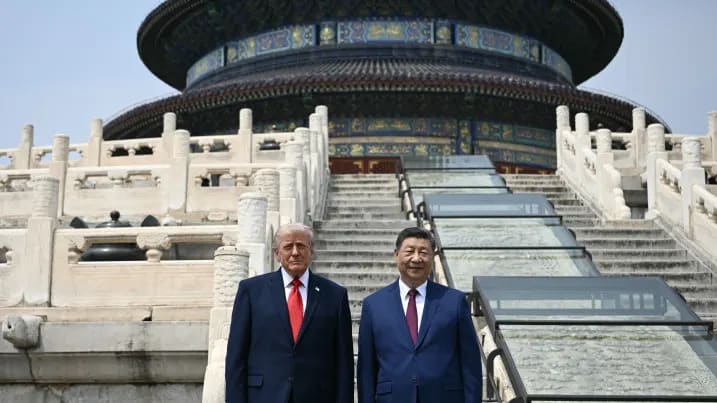
US Treasury Secretary Scott Bessent told CNBC on May 14 2026 that Washington can hold discussions with Beijing on artificial intelligence because we are in the lead Bessent spoke from Beijing during President Donald Trump two day meeting with Chinese President Xi Jinping and said the two countries would establish a protocol for AI safety adding that they were having a wholesome dialogue because the US remains ahead in the race to develop frontier models
The statement marks a shift toward formal US China engagement on AI risk at a time when both countries are racing to scale large language models and deploy autonomous agents The protocol is framed around best practices to ensure non state actors do not get a hold of these models
What was announced at the Trump Xi meeting
One AI safety protocol framework Bessent said the two AI superpowers are gonna start talking We re gonna set up a protocol in terms of how do we go forward with best practices for AI to make sure non state actors don t get a hold of these models The scope was not detailed but the language mirrors prior discussions on model security access controls and red teaming standards for frontier systems
The reason we are able to have wholesome discussions with the Chinese on AI is because we are in the lead he added I do not think we would be having the same discussions if they were this far ahead of us This framing positions US export controls and model lead as leverage for negotiating safety norms
Two Chip export policy remains fluid Bessent was asked about a Reuters report that Washington had cleared sales of Nvidia H200 AI chips to several major Chinese technology firms He said there had been a lot of back and forth on the matter Nvidia CEO Jensen Huang joined Trump delegation to China as a late addition signaling that chip supply remains a live negotiation point US policy has restricted sales of advanced semiconductors to China since 2022 with periodic adjustments based on diplomatic and commercial calculations
Three Taiwan and broader security context Beijing readout said Xi emphasized that Taiwan is the most important issue for bilateral relations and warned against mishandling the issue Bessent told CNBC that Trump would say more on Taiwan in the coming days The AI talks are happening alongside unresolved trade and security disputes which means any protocol will likely be narrow and technical rather than comprehensive
Context on US China AI competition
One US lead in frontier models Bessent claim of lead reflects current benchmark results where US labs OpenAI Google DeepMind Anthropic maintain advantage on general capability and reasoning Anthropic recent Mythos AI model has alarmed Washington due to reported cyberattack capabilities and the company decision to release it only to select business partners The US lead is not permanent and depends on access to advanced chips talent and compute infrastructure
Two China response and domestic push China has prioritized domestic chip development and model training to reduce dependence on US technology Firms like Baidu Alibaba DeepSeek and ByteDance have released models with improving performance The gap is narrowing in some areas but US restrictions on high end GPUs continue to constrain training at the frontier scale
Three Multilateral AI governance efforts The bilateral protocol fits into a broader pattern of states seeking norms for AI safety without slowing deployment The UK AI Safety Summit 2023 and UN AI advisory body work have pushed for risk based frameworks but enforcement remains limited A US China protocol could set a floor for model security and information sharing but will face skepticism given strategic rivalry
Implications for industry and policy
One Near term impact on model releases Bessent said he anticipates a big step function jump in upcoming large language model releases from Google Gemini and OpenAI If true this would widen the capability gap and strengthen US negotiating position It also raises stakes for safety testing and responsible deployment practices
Two Corporate exposure Nvidia and other chip firms remain exposed to policy shifts Any clearance for H200 sales to China would be significant for revenue but politically sensitive The presence of Jensen Huang in Beijing signals that industry is seeking clarity on what is permissible
Three Risk of leakage and misuse The stated goal of the protocol is to prevent non state actors from accessing advanced models This points to shared concern about model weights leaking and being used for cyberattacks or bioweapon assistance Both sides have an interest in avoiding catastrophic misuse even if they compete on commercial deployment
What to watch next
One Concrete measures The protocol needs to specify what counts as best practice Is it secure model storage mandatory red teaming watermarking for synthetic content or restrictions on fine tuning The absence of detail means the announcement is a starting point not a binding agreement
Two Verification and trust Any agreement requires a way to verify compliance US and China have limited trust on technology issues so monitoring will be a sticking point One likely path is third party audits and information sharing on incidents rather than direct inspection
Three Link to export controls If the US sees the protocol as working it may keep current chip restrictions in place If talks stall restrictions could tighten The connection between safety dialogue and trade policy makes this a high stakes negotiation
For companies building frontier models the message is that safety is becoming a diplomatic issue not just a product feature For governments the test is whether a narrow technical agreement can survive wider strategic friction
Do you think a US China AI safety protocol can work without addressing export controls on advanced chips Share your view in the comments