
Contributing Writer
Feature
May 15, 20267 mins
The complexity of modern networks and data centers has made it impossible to rely solely on manual oversight.
Hybrid cloud architectures, SD-WAN overlays, and multi-vendor environments have created configuration sprawl that teams cannot track by hand. At the same time, GPU clusters have pushed data center power loads well beyond what traditional facility planning handles. Average rack density was just 7 kW in 2021, according to AFCOM. AI training racks now routinely exceed 30 kW, and Nvidia’s GB200 NVL72 systems can spike past 150 kW per rack, according to the Uptime Institute.
Digital twin technology addresses these problems: Build an accurate model of the real environment, then use it to test changes before they reach production.
For network teams, digital twin technology provides a continuously updated behavioral model built from device configuration and state data. For data center engineers, it provides a virtual replica of the physical facility where rack layouts, cooling configurations and power loads can be simulated before hardware is touched.
What a digital twin actually does
A digital twin is a virtual representation of an environment and it synchronizes with the live environment continuously, which distinguishes it from static simulations built during a project’s design phase.
For networks, that means collecting configuration and state data continuously across every device, including routers, switches, firewalls, load balancers and cloud environments. All that information is updated in the model as the infrastructure changes. Network teams query the model to evaluate the impact of a planned change, test different approaches and validate that an update accomplishes its goals before pushing it to production.
For data centers, the twin uses computational fluid dynamics and electrical simulation to model the facility. Engineers can test rack layout changes, cooling strategy shifts and equipment additions to identify hot spots, power overloads and containment failures before any physical work begins.
Where each type of twin proves out
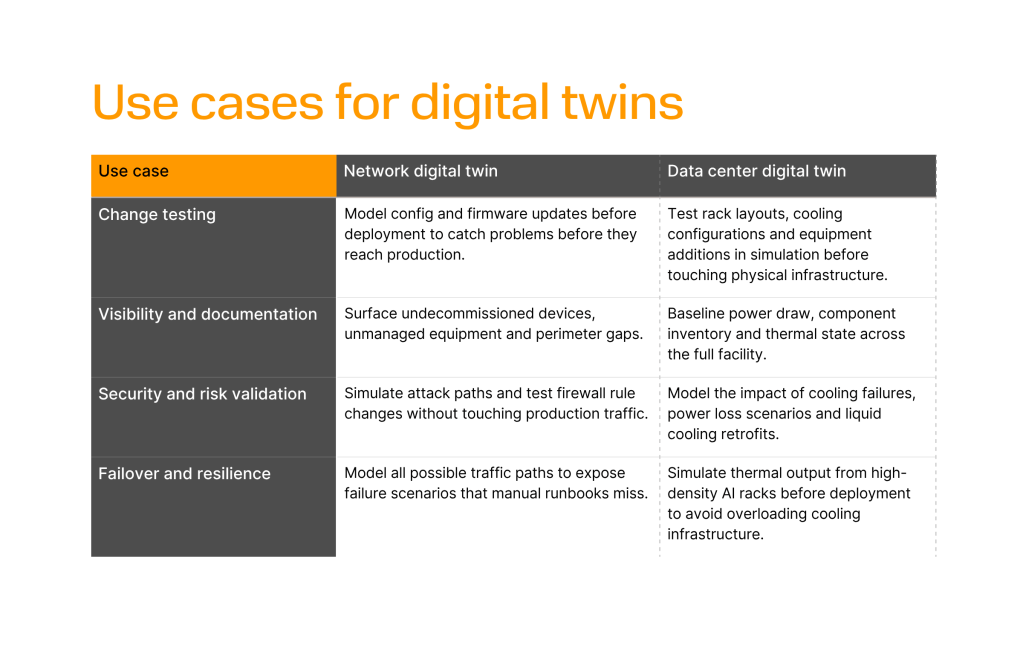
Network twins and data center twins address the same categories of operational risk, applied to different infrastructure layers:
Foundry
On the network side, Gartner estimates that organizations modeling configuration and firmware updates through a digital twin can reduce unplanned outages by 70%.
A Network World report on enterprise digital twin deployments found that one Asperitas Consulting client running failover simulations uncovered failure scenarios that had never appeared in manual testing. Documentation failures compound the risk. Poor documentation is a near-universal problem in enterprise networks, and a Network World report on Fiserv’s deployment of Forward Networks’ platform found devices that were never properly decommissioned, along with circuits that should have been retired years earlier. Without that visibility, unknown devices go unpatched and perimeter risk from untracked CVEs goes unmanaged.
How AI layers onto both types of twin
AI is being applied to digital twins in two distinct ways: as a querying and reasoning layer that makes the model easier to work with, and as an autonomous agent that acts on the model.
Querying and natural language interfaces. On the network side, engineers can now query a digital twin in plain English rather than writing structured queries against the underlying data model. The twin answers questions about network state, policy conflicts and the predicted impact of a planned change. The reason this works reliably is the twin itself: because the model is mathematically verified against the live network, AI outputs are grounded in accurate data rather than probabilistic inference. Without a verified twin as a foundation, language model outputs in network operations carry significant misconfiguration risk.
On the data center side, AI-accelerated simulation tools can compress hours-long CFD calculations into seconds, enabling engineers to run what-if scenarios during planning rather than waiting for overnight simulation jobs.
Agentic operations. The more significant shift is AI systems that plan and execute multi-step workflows autonomously. On the network side, this means agents that can take a trouble ticket, gather relevant context from the digital twin, run diagnostic path traces and return a root cause assessment, without a human driving each step.
What’s next for networking and data center digital twins
Uptime Institute’s 2026 data center predictions report identified reinforcement learning and hybrid digital twins for cooling and power optimization as the near-term operational focus for the industry, with the stated goal being reduced manual effort and improved consistency rather than full autonomy.
The same trajectory applies to network operations: routine troubleshooting, change validation and compliance checks are increasingly handled with less human intervention, with the digital twin providing the verified data foundation that makes autonomous action reliable.
Deployment of both network and data center digital twins is still concentrated in large, complex environments: organizations with enough infrastructure sprawl, configuration risk, or AI-driven rack density to justify the investment. That profile is expanding. Hybrid cloud architectures are pushing network complexity beyond what manual oversight can manage. AI workloads are pushing data center power density beyond what traditional facility planning handles.
Digital twins are no longer a large-enterprise edge case. They are becoming a baseline planning tool for networks and data centers of all sizes.
SUBSCRIBE TO OUR NEWSLETTER
From our editors straight to your inbox
Get started by entering your email address below.
Contributing Writer
Sean Michael Kerner is an IT consultant, technology enthusiast and tinkerer, and has been known to spend his spare time immersed in the study of the Klingon language and satellite pictures of Area 51. He has pulled Token Ring, configured NetWare and has been known to compile his own Linux kernel. He consults to industry and media organizations on technology issues.
Sean's writing has appeared in VentureBeat, InternetNews, TechTarget, ITPro Today, Data Center Knowledge, and TechCrunch, among other outlets.
More from this author
Versa takes aim at fragmented enterprise security with CSPM, orchestration update, and AI agent controls
May 12, 2026 6 mins
Gluware’s Titan rises to meet Mythos network vulnerability challenge
May 7, 2026 5 mins
Lumen advances cloud networking vision with $475M Alkira buy
May 6, 2026 4 mins
Ruckus Networks on the move again, this time acquired by Belden for $1.85 billion
May 4, 2026 5 mins
StarlingX 12.0 is right on time for mixed-hardware edge deployments
May 4, 2026 5 mins
Auvik bets agentic AI can fill the networking skills gap
Apr 29, 2026 6 mins
How Zero Networks is closing the network enforcement gap for AI agents
Apr 21, 2026 5 mins
Cloudflare wants to rebuild the network for the age of AI agents
Apr 20, 2026 6 mins