
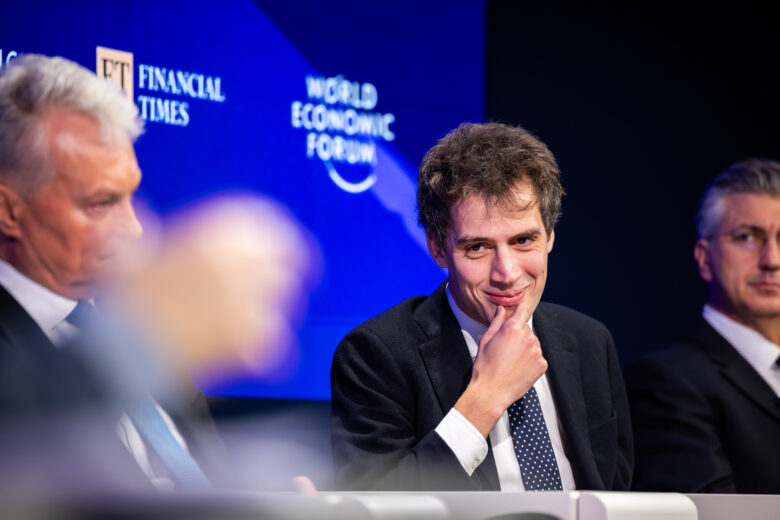
Arthur Mensch, CEO of French AI startup Mistral AI, has warned against Europe’s growing dependence on American tech giants in artificial intelligence. The window for action is limited.
During a hearing before the French National Assembly on Tuesday, May 13, 2026, Mensch set a clear deadline: Europe must build its own AI infrastructure within the next two years, or face permanent technological dependence on the US.
“Vassal State” Warning
The 33-year-old Mistral co-founder chose his words carefully. If Europe continues importing digital services from the United States without developing its own capabilities, the continent could become a “vassal state.” “Once the supply is monopolized by American players, we suddenly have no supply left and can no longer convert electrons into tokens,” Mensch said, referring to the conversion of computing power into AI-generated output.
The AI competition is increasingly a battle for access to energy, chips, and data center capacity, explained the former Meta and DeepMind researcher. US tech companies are already aggressively securing these resources. “The Americans are deploying one trillion dollars next year. Whoever controls the chips, whoever controls the electrons, whoever has massive access to energy – that’s who wins,” Mensch said.
Mistral AI, founded in 2023 and valued at around $14 billion, plans to build one gigawatt of AI computing capacity by 2029. However, Mensch indicated that Europe will need far more infrastructure investment in the long term.
The Paris-based startup recently reinforced its digital sovereignty strategy with a partnership with Groupe Caisse des Dépôts. The French state investment institution will work with Mistral on generative AI and GPU computing infrastructure.
Criticism of European Framework Conditions
Mensch also criticized Europe’s fragmented regulations and capital markets. These make it significantly harder for startups to scale – unlike in the United States. “If we don’t act quickly enough, we will end up in a situation where we have no choice left,” he warned. “In a world where you import all digital services from the United States, you have no leverage against the US.”
Europe’s Most Valuable AI Startup
Since its founding in April 2023, Mistral AI has completed several major funding rounds, making it one of the best-capitalized AI startups in Europe. The development shows the rapid rise in valuation over just a few years:
| Round | Date | Amount | Valuation | Lead Investors | Other Investors |
|---|---|---|---|---|---|
| Seed | June 2023 | €105M (~$117M) | ~$270M | Lightspeed Venture Partners | Eric Schmidt, Xavier Niel, JCDecaux, Motier, Sofina, LocalGlobe |
| Series A | December 2023 | €385M (~$428M) | ~$2B | Andreessen Horowitz | Lightspeed, Salesforce Ventures, BNP Paribas, Bpifrance |
| Series B | June 2024 | €600M (~$640M) | $6B | General Catalyst | Andreessen Horowitz, Lightspeed, BNP Paribas, Nvidia, Salesforce, IBM, Microsoft |
| Series C | September 2025 | €2B (~$14B) | €12B (~$14B) | ASML | Existing Investors |
Mistral AI has established itself as by far the most valuable AI startup in Europe. With a valuation of around $14 billion, the company sits well ahead of its nearest competitors: Legal-tech provider Legora reached a $5.6 billion valuation in April 2026, while no-code development provider Lovable was valued at $6.6 billion in late 2025. Mistral thus exceeds these figures by more than double.
More significant, however, is Mistral’s technological positioning: The Paris-based company is among the few firms in Europe that develop and train their own foundation models – meaning core AI language models. While the majority of European AI startups focus on applications built on American models or offer niche solutions in specific sectors like legal services (Legora) or software development (Lovable), Mistral conducts its own research and develops the underlying models itself. This vertical integration makes the company one of the few genuine technology leaders on the continent capable of competing at the model level with OpenAI, Anthropic, or Google DeepMind.
It is precisely this ability to independently develop models that CEO Arthur Mensch emphasizes as a strategic advantage for Europe’s digital sovereignty. Without its own model capabilities, he argues, Europe will remain permanently dependent on American technology decisions – regardless of the valuation of individual application startups.

Aus Datenschutz-Gründen ist dieser Inhalt ausgeblendet. Die Einbettung von externen Inhalten kann in den Datenschutz-Einstellungen aktiviert werden: