
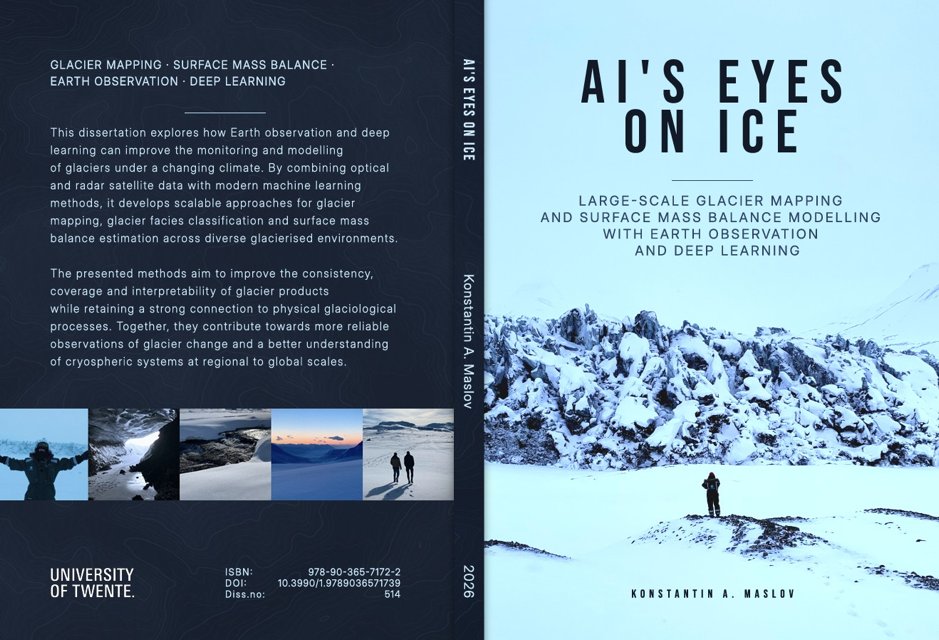
AI's Eyes on Ice: Large-Scale Glacier Mapping and Surface Mass Balance Modelling with Earth Observation and Deep Learning
Konstantin Maslov is a PhD student in the Department of Earth Observation Science. (Co)Promotors are prof.dr.ing. C. Persello, prof.dr. A. Stein from the Faculty of ITC and dr. T. Schellenberger from the University of Oslo.
 Glaciers are among the clearest indicators of climate change. Their retreat affects sea level, regional water resources, ecosystems and cryospheric hazards, while also providing direct evidence of changes in temperature and precipitation patterns. Monitoring glaciers consistently across space and time, however, remains challenging. Many glacier products still rely on sparse observations, manual mapping or semi-automated methods that are difficult to apply repeatedly over large regions.
This dissertation investigates how Earth observation and deep learning can improve the mapping and modelling of glaciers. It develops GeoAI methods that combine multi-modal datasets and physically guided modelling to produce more consistent glacier products at a large scale. The research addresses several connected tasks: automated glacier outline mapping, glacier facies classification and surface mass balance modelling.
The thesis shows that modern deep learning methods can delineate glacier outlines across diverse environments on par with human experts and provide calibrated predictive confidence estimates that help interpret automated results. It further demonstrates that radar time series can support annual glacier inventories in cloudy regions, where optical imagery is often limited. Beyond glacier extent, the dissertation introduces a large-scale glacier facies mapping method to describe surface conditions such as snow, firn, bare ice or supraglacial debris. These surface states are shown to be relevant for understanding accumulation and ablation processes. Finally, the dissertation develops a hybrid surface mass balance model that combines a traditional temperature index formulation with a neural correction component. This approach aims to improve transferability across glaciers while retaining a clear connection to physical glaciological processes.
Jointly, the results contribute to more consistent, large-scale and uncertainty-aware glacier monitoring. By linking satellite observations, machine learning and physical process understanding, the dissertation supports the development of glacier essential climate variable products for scientific assessment and climate-related decision making.