
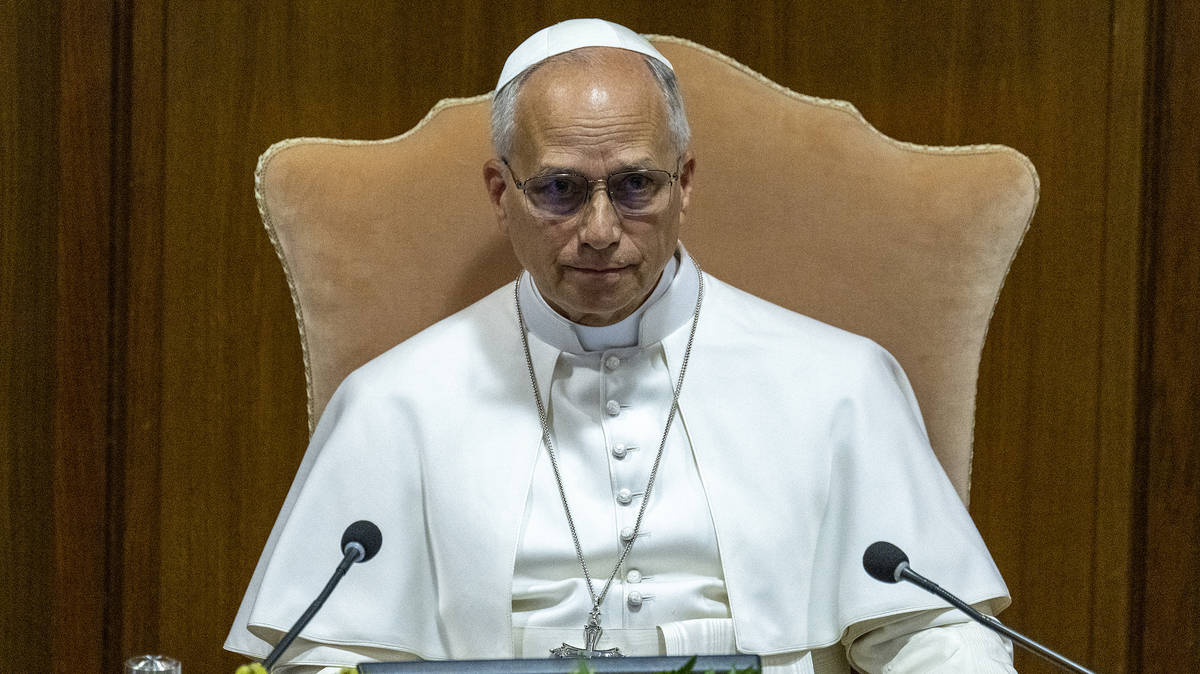
Pope Leo calls for more regulation of AI warning some weapons systems are 'beyond human control'
The remarks will likely heighten friction with US President Trump, whose administration has worked to deregulate the development of AI
| Updated: 2h ago

By Issy Clarke
Pope Leo has called on governments to do more to regulate artificial intelligence (AI) in his first major teaching since becoming pontiff.
Loading audio...
The first US pope warned AI systems spread misinformation, prioritise conflict and risk leading the world down a path of unending war.
Pope Leo also expressed concern at a Vatican event launching the text that some autonomous weapons systems have advanced "practically beyond any human reach to govern them".
The text, titled Magnifica Humanitas (Magnificent Humanity), has been highly anticipated since Leo's election as pope just over a year ago, and set out his calls for more political involvement to regulate AI.
The remarks will likely contribute to friction between the pontiff and the US President, whose administration has worked to deregulate the development of AI.
Read more: Pope Leo makes another swipe at Trump just hours after the US president's firing squad announcement
Read more: World 'being ravaged by a handful of tyrants', warns Pope Leo after Trump criticism

"What is needed is a more active political involvement that is capable of slowing things down when everything is accelerating," Leo said in the text.
The pope called for "robust legal frameworks, independent oversight, informed users and a political system that does not abdicate its responsibility."
Leo also expressed concern that leaders could start wars to distract citizens from domestic issues.
"We cannot rule out the possibility that some leaders may consider armed conflict as an effective way of diverting attention from domestic problems and a cynical tool for managing difficulties," he stated.
Founder of Anthropic Chris Olah, who attended the event on Monday, thanked Leo for addressing the problems raised by the disruptive, new technology. He said firms like his faced strong commercial pressures and needed outside scrutiny.
"Every frontier AI lab, including Anthropic, operates inside a set of incentives and constraints that can sometimes conflict with doing the right thing," Olah said. Anthropic is the company that produces the Claude AI tools.

The pope also brought in a Lord of the Rings reference, invoking Gandalf in his call for people to do their part to build a "civilization of love".
Quoting JRR Tolkein's legendary wizard in The Return of the King, he said: "It is not our part to master all the tides of the world, but to do what is in us for the succour of those years wherein we are set, uprooting the evil in the fields that we know, so that those who live after may have clean earth to till."
He said a civilisation of love "will not arise from a single or spectacular gesture, but from the sum total of small and steadfast acts of fidelity that serve as a bulwark against dehumanization".
He also used the 43,000 word text, known as an encyclical, to issue the most comprehensive apology for the church's involvement in the 19th century slave trade so far.
Decrying "new forms of slavery" generated by AI - including people tending AI systems and factory workers who produce the technological devices - he went on to acknowledge that the Catholic Church did not forcefully condemn transatlantic slavery until the 19th century.
"This constitutes a wound in Christian memory," he wrote. "For this, in the name of the Church, I sincerely ask for pardon."