
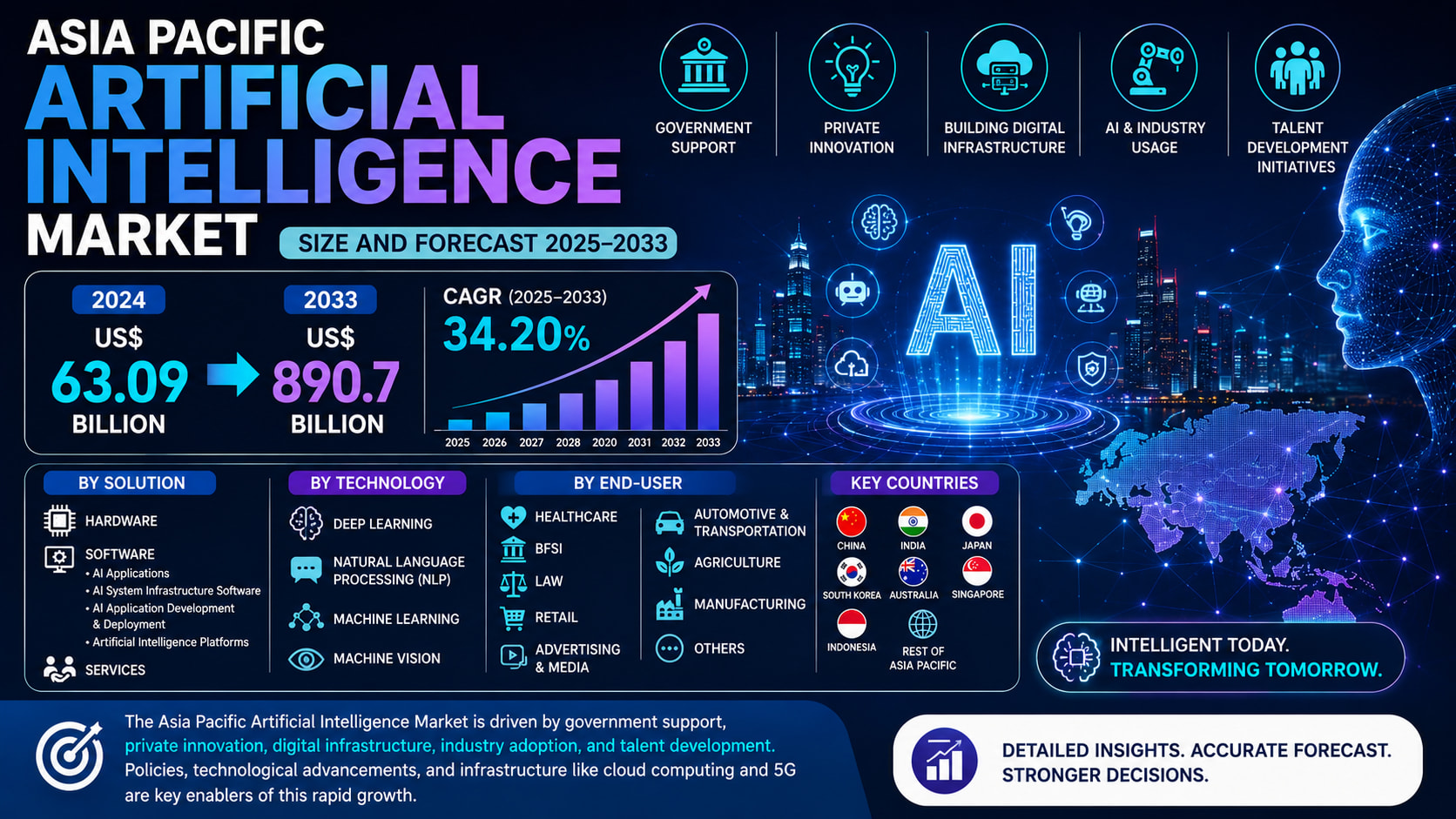
The Asia Pacific artificial intelligence market is entering an extraordinary growth phase as governments, technology companies, and enterprises rapidly accelerate investments in AI technologies and digital infrastructure. According to Renub Research, the Asia Pacific Artificial Intelligence Market is expected to surge from US$ 63.09 billion in 2024 to US$ 890.7 billion by 2033, expanding at a remarkable CAGR of 34.20% from 2025 to 2033. Government support, rapid private-sector innovation, expanding cloud infrastructure, rising industry adoption, and continuous advancements in technologies such as machine learning and natural language processing are among the major forces driving market expansion.
Artificial intelligence is increasingly transforming industries by enabling machines and software systems to mimic human intelligence and perform tasks such as problem-solving, decision-making, speech recognition, predictive analytics, automation, and language understanding. AI technologies now play a critical role in healthcare, finance, retail, manufacturing, transportation, telecommunications, and agriculture.
The Asia Pacific region has emerged as one of the world’s fastest-growing AI ecosystems due to its massive digital population, growing startup environment, strong government backing, and rapidly expanding internet infrastructure.
AI Adoption Across Industries Is Accelerating Rapidly
The increasing adoption of AI-enabled systems across industries is one of the strongest drivers supporting the Asia Pacific AI market. Businesses are using artificial intelligence to improve operational efficiency, automate repetitive tasks, analyze massive datasets, and enhance customer experiences.
According to the uploaded report, sectors such as banking, financial services, insurance (BFSI), healthcare, and telecommunications are increasingly integrating AI systems to process large amounts of data and generate valuable business insights.
In healthcare, AI is improving medical imaging, diagnostics, drug discovery, treatment planning, and hospital workflow management. In finance, AI-powered systems are helping institutions strengthen fraud detection, automate customer support, optimize risk analysis, and personalize banking services.
Retailers are increasingly using AI for demand forecasting, recommendation engines, pricing optimization, and inventory management. Manufacturers are implementing AI-powered predictive maintenance systems and automation technologies to improve productivity and reduce downtime.
The growing use of AI-powered virtual assistants, chatbots, and intelligent automation systems is also accelerating enterprise AI adoption across the region.
Government Initiatives Are Creating a Strong Foundation for AI Growth
Government support remains one of the biggest growth catalysts for the Asia Pacific artificial intelligence market. Several countries across the region are aggressively promoting AI development through strategic policies, funding initiatives, research partnerships, and regulatory frameworks.
The uploaded report highlights major initiatives from countries such as China, South Korea, and Japan that are accelerating AI innovation and adoption.
South Korea’s “I-Korea 4.0” initiative focuses on strengthening AI capabilities across multiple industries, while China continues pursuing ambitious long-term goals aimed at becoming a global AI leader by 2030.
Japan is also heavily investing in AI-related research, industrial automation, and semiconductor testing technologies to strengthen global competitiveness.
Governments throughout Asia Pacific are additionally supporting AI development through grants, startup funding programs, talent development initiatives, cloud infrastructure investments, and public-private partnerships.
These supportive policies are helping attract domestic and international investments while creating favorable environments for innovation and commercialization.
Private Sector Innovation Is Expanding the AI Ecosystem
Private technology companies are playing a major role in shaping the Asia Pacific AI landscape. Leading firms are investing heavily in generative AI, cloud computing, machine learning, robotics, semiconductor technologies, and AI-driven software applications.
The uploaded report highlights Nvidia’s April 2024 partnership with Indonesian telecommunications company Indosat Ooredoo Hutchison to build a US$ 200 million AI complex in Indonesia.
This development reflects Southeast Asia’s growing importance in the global AI ecosystem and demonstrates how companies are expanding infrastructure investments to meet rising AI demand.
Private-sector innovation is also accelerating AI competition across Asia Pacific. Companies are racing to launch smarter AI applications, generative AI platforms, intelligent devices, and cloud-based AI services to capture rapidly growing market opportunities.
Technology firms are increasingly collaborating with governments, universities, telecom providers, and enterprises to strengthen AI research, deployment, and commercialization.
These partnerships are helping position Asia Pacific as a global center for artificial intelligence innovation.
Cloud Computing and 5G Infrastructure Are Supporting AI Expansion
Cloud computing and 5G infrastructure are becoming critical foundations for AI growth throughout Asia Pacific. AI applications require massive processing power, high-speed connectivity, and scalable computing resources to function efficiently.
The report states that advancements in infrastructure technologies such as cloud computing and 5G are significantly contributing to market growth.
The expansion of hyperscale data centers and cloud platforms is allowing businesses to deploy AI solutions more efficiently without investing heavily in on-premise infrastructure.
Meanwhile, 5G networks are enabling real-time data processing, edge computing, autonomous systems, smart city applications, and AI-powered Internet of Things (IoT) devices.
The combination of cloud computing, edge AI, and ultra-fast connectivity is expected to create substantial opportunities for AI deployment across industries including transportation, healthcare, manufacturing, and telecommunications.
Generative AI Is Emerging as a Major Industry Trend
Generative AI has become one of the fastest-growing segments within the artificial intelligence industry. Companies across Asia Pacific are increasingly investing in AI systems capable of generating text, images, code, videos, and conversational responses.
The uploaded report highlights Google’s launch of the beta version of Search Generative Experience (SGE) in November 2023 to improve AI-powered search experiences.
Generative AI technologies are rapidly transforming content creation, software development, customer engagement, education, and enterprise productivity.
Businesses are increasingly adopting generative AI to automate workflows, improve decision-making, and reduce operational costs. At the same time, startups across the region are developing specialized AI tools for healthcare, legal services, media, customer service, and industrial automation.
As enterprises continue exploring AI-driven productivity improvements, generative AI adoption is expected to accelerate significantly during the forecast period.
China Artificial Intelligence Market Leads Global AI Competition
China remains one of the largest and most influential AI markets globally due to strong government backing, rapid private-sector innovation, and aggressive investment strategies.
The uploaded report states that China aims to become the global leader in artificial intelligence by 2030.
Major Chinese technology companies such as Baidu, Alibaba, and Tencent are leading innovation in AI applications related to healthcare, autonomous vehicles, smart cities, cloud computing, and finance.
One major development mentioned in the report is Alibaba’s September 2023 strategic partnership with local governments to develop smart city projects integrating AI into transportation and urban management systems.
China’s strong manufacturing ecosystem, extensive digital infrastructure, and large domestic technology market continue to strengthen its global AI position.
India Artificial Intelligence Market Expands Rapidly Through Collaboration and Innovation
India is rapidly becoming one of the fastest-growing AI markets in Asia Pacific due to government initiatives, startup activity, and growing enterprise adoption.
The uploaded report highlights India’s “IndiaAI” initiative, which promotes AI research, innovation, and industry collaboration.
A major development noted in the report is the October 2024 partnership between India’s Ministry of Electronics and Information Technology (MeitY) and Meta to support open-source AI innovation and establish the Srijan Centre for Generative AI at IIT Jodhpur.
India’s rapidly growing digital economy, expanding startup ecosystem, large engineering workforce, and increasing cloud adoption are creating strong opportunities for AI deployment across multiple sectors.
AI applications in India are increasingly being used in agriculture, education, healthcare, fintech, logistics, and e-commerce.
Japan Artificial Intelligence Market Focuses on Industrial Automation
Japan’s AI market is being strongly supported by government investments, industrial automation initiatives, and academic research partnerships.
According to the uploaded report, Japanese companies such as Hitachi and Advantest are increasingly integrating AI into semiconductor testing and industrial automation processes.
Japan is also investing heavily in robotics, smart manufacturing, healthcare AI, and intelligent transportation systems to improve productivity and global competitiveness.
Academic institutions and corporate collaborations are helping strengthen AI talent development and research capabilities throughout the country.
Japan’s advanced industrial ecosystem and strong focus on automation position it as one of the most technologically advanced AI markets globally.
Data Privacy and Security Remain Major Concerns
Despite strong growth opportunities, the Asia Pacific AI market faces important challenges related to data privacy and cybersecurity.
The uploaded report states that rapid AI adoption has increased concerns regarding data protection, cybersecurity risks, and compliance with varying national privacy regulations.
AI systems often process large volumes of sensitive consumer and enterprise data, increasing the risk of security breaches and regulatory scrutiny.
As governments strengthen data governance frameworks, companies will need to invest heavily in cybersecurity, ethical AI development, and compliance systems to maintain consumer trust and regulatory approval.
Ethical and Regulatory Challenges Continue to Affect AI Development
Ethical concerns surrounding AI bias, transparency, accountability, and decision-making continue to create challenges for the industry.
According to the uploaded report, the absence of standardized AI governance frameworks across countries complicates the development and deployment of AI technologies.
Governments and technology companies are increasingly focusing on responsible AI development to ensure fairness, transparency, and ethical implementation of AI-powered systems.
Creating balanced regulatory frameworks will remain essential for maintaining innovation while protecting consumers and businesses from misuse of AI technologies.
Recent Developments by Leading AI Companies
- Nvidia partnered with Indosat Ooredoo Hutchison to develop a US$ 200 million AI infrastructure project in Indonesia.
- Google launched the beta version of Search Generative Experience (SGE) to strengthen AI-powered search capabilities.
- Meta partnered with IndiaAI and MeitY to establish the Srijan Centre for Generative AI at IIT Jodhpur.
- Alibaba expanded smart city partnerships integrating AI into transportation and urban management systems.
- Baidu continued investing heavily in autonomous driving and AI cloud services.
- Microsoft expanded enterprise AI and cloud-based generative AI solutions across Asia Pacific.
- Amazon strengthened AI-powered cloud infrastructure and enterprise automation services.
- IBM increased focus on AI-powered business analytics and hybrid cloud technologies.
- Salesforce accelerated deployment of AI-driven customer relationship management solutions.
- Oracle expanded AI-integrated enterprise software and cloud computing capabilities.
- Competitive Landscape Remains Highly Dynamic
- The Asia Pacific artificial intelligence market remains highly competitive and innovation-driven, with global technology leaders and regional firms investing aggressively in AI research, cloud infrastructure, and enterprise solutions.
- Companies covered in the report include Microsoft Corporation, IBM Corporation, Amazon, Baidu Inc., Nvidia Corporation, Oracle Corporation, Hewlett Packard Enterprise, Salesforce Inc., and Alphabet Inc.
- Competition is increasingly centered around generative AI capabilities, cloud integration, AI infrastructure, enterprise automation, and industry-specific AI applications.
Final Thoughts
The Asia Pacific artificial intelligence market is entering a transformational era driven by government support, rapid enterprise adoption, private-sector innovation, and expanding digital infrastructure. Renub Research’s projection of the market reaching US$ 890.7 billion by 2033 highlights the extraordinary scale of future growth opportunities across the region.
Artificial intelligence is rapidly becoming a core technology shaping the future of healthcare, finance, manufacturing, transportation, education, retail, and digital services. As cloud computing, 5G networks, generative AI, and automation technologies continue advancing, Asia Pacific is expected to remain one of the most influential global AI growth centers.
Although challenges related to regulation, ethics, and data security remain significant, ongoing innovation and strong investment momentum are likely to ensure sustained long-term growth for the region’s artificial intelligence industry.