
18 min read
Just now
--
Your clinical AI is regulated by HIPAA, the 2026 Security Rule update, the EU AI Act, the Colorado AI Act, and state disclosure laws. Simultaneously. Here’s the unified governance architecture that satisfies all five without building five separate compliance programs.
Press enter or click to view image in full size
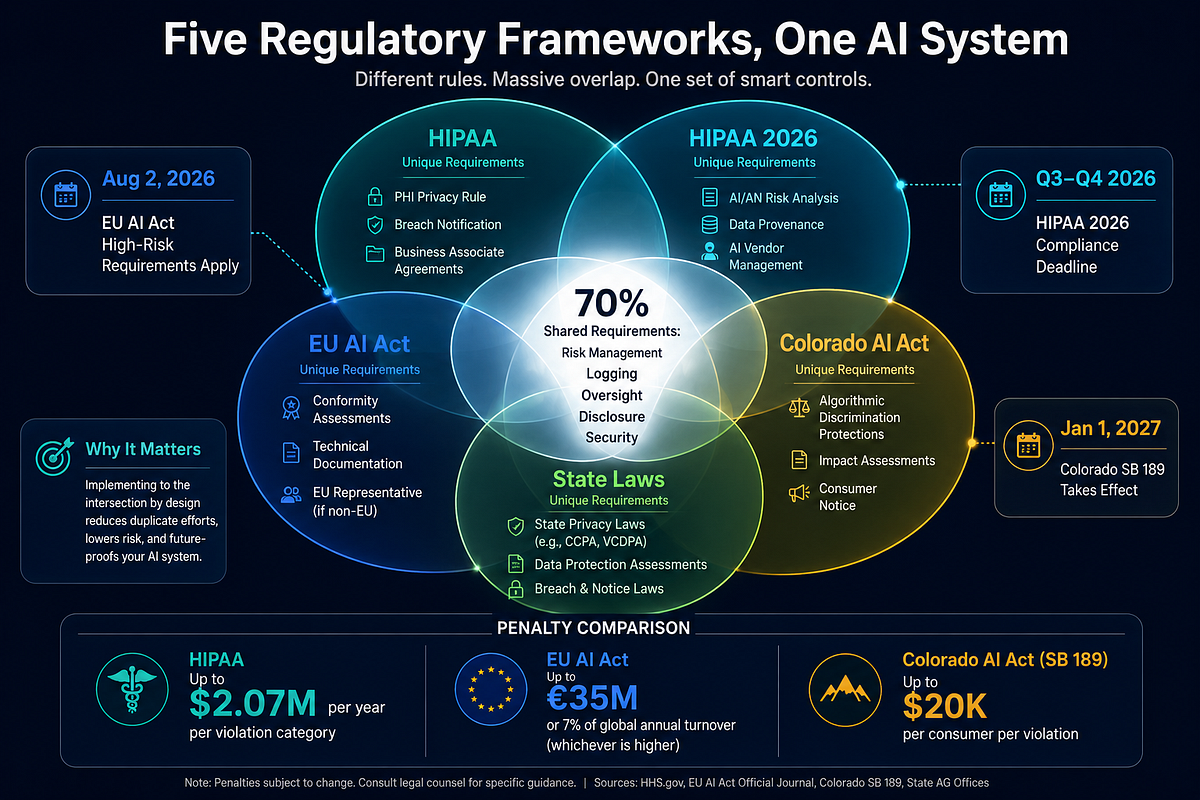
Regulatory convergence is the compliance crisis that arrives when healthcare organizations deploying clinical AI discover that their single system is simultaneously subject to five or more frameworks: HIPAA (1996, largely unchanged since 2013), the proposed 2026 HIPAA Security Rule overhaul (mandatory encryption, MFA, annual risk assessments, network segmentation, 72-hour recovery), the EU AI Act (high-risk AI enforcement August 2, 2026, penalties up to €35M or 7% revenue), the Colorado AI Act as amended by SB 26–189 (automated decision-making technology, effective January 1, 2027, $20,000 per consumer per violation), and an expanding patchwork of state AI disclosure laws requiring patient notification when AI influences care decisions. After building compliance architecture for 11 production AI deployments across healthcare, financial services, and government, I’ve mapped where these five frameworks overlap (70% shared requirements), where they conflict (data retention timelines, consent models, human oversight definitions), and how a single governance layer satisfies all five without duplicating effort. The compliance officer dropped the spreadsheet on the table: five columns, one for each regulatory framework. Every row was a requirement. The AI system had to satisfy all of them.
“We can’t build five compliance programs,” the CTO said.
“You don’t have to,” I told him. “70% of these requirements are the same thing asked five different ways.”
This is the architecture that satisfies all five.
The Five Frameworks (And Why They All Apply to Your AI)
If you’re reading this, at least three of these apply to your AI system right now. If you serve patients or customers across state lines or international borders, all five may apply simultaneously.
Framework 1: HIPAA Security Rule (Current)
Applies to: Any covered entity or business associate processing ePHI
Key AI requirements:
- Audit controls for systems touching ePHI (§164.312(b)) — covered in Episode 13 of this series
- Access controls and authentication (§164.312(a))
- Transmission security (§164.312(e))
- Risk analysis and management (§164.308(a)(1))
Penalties: $137-$68,928 per violation, up to $2.07M per identical violation per year (2026 inflation-adjusted tiers)
What most organizations miss: HIPAA applies to AI systems the moment they process ePHI. “It’s just an AI pilot” is not an exemption. OCR investigated 21 cases in 2025, collecting $8.3M, with risk analysis failures in 75%+ of cases.
Framework 2: 2026 HIPAA Security Rule Update
Status: Proposed rule published January 6, 2025. Final rule expected Q2-Q3 2026. Compliance deadline: 180 days after publication (likely Q3-Q4 2026).
What changes from current HIPAA:
The current HIPAA Security Rule was written in 2003. It predates cloud computing, telehealth, AI, and ransomware-as-a-service.
New requirements (verified from proposed rule):
- “Required” replaces “addressable”: Every safeguard becomes mandatory. No more “we assessed it and decided not to implement encryption.” Encryption is now required, not addressable.
- Universal ePHI encryption: Encryption at rest mandatory (current rule only requires in-transit). Aligns with NIST standards including secure key management.
- Multi-factor authentication: MFA required across all systems touching ePHI. No exceptions.
- Annual security risk assessments: Current rule says “periodic.” New rule says annual, with documented methodology.
- Network segmentation: Required safeguard. Must restrict lateral movement during attacks.
- Comprehensive asset inventory: Must document every device, system, application, and connection point touching ePHI. Including AI tools, cloud services, IoT devices.
- 72-hour system restoration: Must demonstrate ability to restore critical systems within 72 hours after incident.
- Vulnerability scanning: Regular scanning required, not just recommended.
- Annual vendor verification: Written verification from business associates confirming technical safeguards. Signed BAA alone is no longer sufficient.
- AI-specific provisions: AI training data, prediction models, and algorithm outputs explicitly brought under HIPAA protection.
Industry-wide first-year compliance cost: $9 billion (HHS Regulatory Impact Analysis estimate), approximately $30K-$80K per mid-market covered entity.
What this means for AI systems: If your clinical AI touches ePHI, every one of these requirements applies to it. Asset inventory must include AI. Risk assessment must cover AI. Encryption must cover AI data at rest. MFA must cover AI system access. Network segmentation must isolate AI infrastructure.
Source: Medcurity (May 2026), CBIZ (April 2026), Petronella Cybersecurity (April 2026), HIPAA Journal (2026)
Framework 3: EU AI Act (Regulation EU 2024/1689)
Applies to: Any AI system placed on the EU market OR affecting EU citizens, regardless of where the provider is located
Timeline (verified):
- February 2, 2025: Prohibited AI practices enforceable (€35M or 7% revenue penalties)
- August 2, 2025: General-purpose AI model rules apply
- August 2, 2026: High-risk AI system obligations fully enforceable
- August 2, 2027: Extended deadline for AI in medical devices under MDR/IVDR
Healthcare AI classified as high-risk (Annex III):
- AI for diagnosis
- Clinical decision support
- Treatment recommendations
- Patient triage
- Patient monitoring
- Emergency call classification and dispatch
Requirements for high-risk AI systems:
- Risk management system (Article 9)
- Data governance (Article 10)
- Technical documentation (Article 11)
- Record-keeping / logging (Article 12)
- Transparency and information to deployers (Article 13)
- Human oversight (Article 14)
- Accuracy, robustness, cybersecurity (Article 15)
- Conformity assessment (Article 43)
- Registration in EU database (Article 49)
Penalties:
- Prohibited practices: €35M or 7% global revenue
- High-risk non-compliance: €15M or 3% global revenue
- Incorrect information: €7.5M or 1% global revenue
What most organizations miss: 75% of commercial AI-enabled medical devices are in radiology, classified as Class IIa or above. If you sell to or serve EU markets, the August 2026 deadline applies now.
Source: Tandem Health (May 2026), Gardner Law (September 2025), Axis Intelligence (May 2026), Harvard Petrie-Flom Center (March 2026)
Framework 4: Colorado AI Act (SB 26–189, as amended May 14, 2026)
Applies to: Any developer or deployer of automated decision-making technology (ADMT) making consequential decisions affecting Colorado residents in healthcare, financial services, employment, housing, insurance, education, or government services
Effective date: January 1, 2027 (revised from original June 30, 2026)
Key changes from original SB 24–205 (signed May 14, 2026):
- Broader scope: Covers “automated decision-making technology” (ADMT), not just “AI systems.” A system that merely checks whether an answer falls within an acceptable range qualifies. No inference required.
- Removed obligations: Duty to use “reasonable care” to prevent algorithmic discrimination eliminated entirely.
- HIPAA exemption: HIPAA covered entities doing business in Colorado are exempted from many developer/deployer obligations UNLESS using ADMT for employment-related decisions. Must still provide patients with general notice about how ADMT is used and specific disclosures when ADMT determines financial assistance eligibility.
- FDA exemption: Medical devices and certain pharma/medical-device R&D subject to FDA regulation are exempt from developer/deployer obligations.
- New liability framework: Contract clauses purporting to indemnify a party for its own discriminatory ADMT-related acts are VOID. Requires immediate review of AI vendor contracts.
- Enforcement: Colorado Attorney General exclusive enforcement. $20,000 per consumer per violation. 60-day cure period required before enforcement action (unless knowing or repeated violations).
- Accessibility: All notices and disclosures must be accessible to consumers with disabilities and limited English proficiency.
What most organizations miss: The HIPAA exemption is NOT total. Healthcare providers still must provide AI disclosure notices to patients. And the voided indemnification clause means your current AI vendor contract may have unenforceable provisions.
Source: Holland & Knight (May 2026), Ropes & Gray (May 2026), Consumer Financial Services Law Monitor (May 2026)
Framework 5: State AI Disclosure Laws (Expanding Patchwork)
Current state as of May 2026:
Multiple states now require disclosure when AI influences consequential decisions. The landscape is fragmented and growing.
Common requirements across state laws:
- Notify patients/consumers when AI is used in decisions affecting them
- Provide explanation of AI’s role in the decision
- Offer human review option
- Document AI system capabilities and limitations
What most organizations miss: Even if you’re HIPAA-exempt under Colorado, state disclosure laws may still require patient notification when AI influences care decisions. The patchwork means multi-state organizations need a disclosure framework that satisfies the strictest state requirement.
Press enter or click to view image in full size
The Overlap Map: Where Five Frameworks Converge
Here’s what nobody shows you: these five frameworks share approximately 70% of their requirements. Building five separate compliance programs is unnecessary and expensive.
Shared Requirement 1: Risk Management
Press enter or click to view image in full size
One risk management system satisfies all five. Design it to the strictest standard (EU AI Act Article 9: continuous, iterative, documented) and every other framework is covered.
Episode 8 (Adversarial Input Decision) covered the security risk assessment component. Episode 13 (Audit Decision) covered the audit trail architecture. Both feed directly into this unified risk management system.
Shared Requirement 2: Logging and Audit Trail
One audit logging system satisfies all five. Build to the 13-field minimum from Episode 13 with 6-year retention. That satisfies HIPAA, exceeds EU AI Act traceability requirements, and covers state documentation needs.
The 13 required fields:
- User identity
- Patient/subject ID
- Timestamp
- Source system
- PHI/PII accessed
- Model version
- Prompt hash
- Output hash
- Clinical/business purpose
- Human reviewer
- Downstream action
- IP/device
- Session ID
Shared Requirement 3: Human Oversight
One human oversight framework satisfies all five. Episode 6 (Output Validation Decision) covered the multi-layer validation architecture. Build human review checkpoints at the same points that satisfy clinical safety and you automatically satisfy EU AI Act Article 14 and state human review requirements.
Shared Requirement 4: Transparency and Disclosure
One disclosure framework satisfies all five. Create a patient-facing AI disclosure that explains: what AI is used for, how it influences decisions, that human review is available, and how to request human-only processing. Make it accessible (Colorado requires disability and limited English proficiency accessibility).
Shared Requirement 5: Data Governance and Security
One security architecture satisfies all five. Build to the 2026 HIPAA Security Rule standard (the strictest): universal encryption, MFA, network segmentation, asset inventory, vulnerability scanning. That automatically satisfies EU AI Act cybersecurity requirements and state security expectations.
Episode 4 (Prompt Logging Decision) covered prompt data security. Episode 5 (Rate Limiting Decision) covered cost and access controls. Episode 12 (Fallback Decision) covered system resilience. All three feed into the unified security architecture.
The Unified Governance Architecture
Layer 1: Risk Management (Continuous)
from dataclasses import dataclass, field
from datetime import datetime
from typing import List, Dict, Optional
from enum import Enumclass RegulatoryFramework(Enum):
    HIPAA_CURRENT = "hipaa_current"
    HIPAA_2026 = "hipaa_2026_update"
    EU_AI_ACT = "eu_ai_act"
    COLORADO_AI = "colorado_sb_189"
    STATE_DISCLOSURE = "state_disclosure_laws"
class RiskLevel(Enum):
    LOW = "low"
    MEDIUM = "medium"
    HIGH = "high"
    CRITICAL = "critical"
@dataclass
class AISystemRegistration:
    """
    Unified AI system registration satisfying all five frameworks        HIPAA: Asset inventory requirement (2026 update)
    EU AI Act: Article 49 registration in EU database
    Colorado: ADMT documentation
    """
    system_id: str
    system_name: str
    description: str
    deployment_date: datetime        # Framework applicability
    applicable_frameworks: List[RegulatoryFramework]        # EU AI Act classification
    eu_risk_classification: Optional[str] = None  # "high-risk", "limited", "minimal"
    eu_annex_category: Optional[str] = None  # e.g., "Annex III, Section 5(a) - healthcare"        # Colorado classification
    colorado_admt_applicable: bool = False
    colorado_consequential_decisions: List[str] = field(default_factory=list)        # HIPAA classification
    hipaa_phi_processing: bool = False
    hipaa_system_type: Optional[str] = None  # "clinical decision support", "documentation", etc.        # Technical details (required by all frameworks)
    model_provider: str = ""  # "OpenAI", "Anthropic", "Self-hosted"
    model_version: str = ""
    data_sources: List[str] = field(default_factory=list)
    phi_elements_processed: List[str] = field(default_factory=list)        # Human oversight (EU AI Act Article 14 + HIPAA standard of care)
    human_oversight_type: str = ""  # "physician review", "analyst approval"
    human_override_available: bool = True        # Deployment scope
    serves_eu_market: bool = False
    serves_colorado_residents: bool = False
    states_served: List[str] = field(default_factory=list)
class UnifiedRiskAssessment:
    """
    Single risk assessment satisfying:
    - HIPAA §164.308(a)(1): Risk analysis
    - HIPAA 2026: Annual documented risk assessment
    - EU AI Act Article 9: Risk management system
    - Colorado SB 26-189: ADMT risk assessment        Built to the strictest standard (EU AI Act: continuous, iterative)
    which automatically satisfies all other frameworks
    """        def __init__(self, ai_system: AISystemRegistration):
        self.system = ai_system
        self.assessments = []        def conduct_assessment(self) -> Dict:
        """
        Unified risk assessment covering all applicable frameworks
        """
        assessment = {
            'assessment_id': f"RA-{datetime.utcnow().strftime('%Y%m%d')}",
            'system_id': self.system.system_id,
            'date': datetime.utcnow().isoformat(),
            'frameworks_covered': [f.value for f in self.system.applicable_frameworks],                        # HIPAA risk categories
            'hipaa_risks': self._assess_hipaa_risks(),                        # EU AI Act risk categories
            'eu_ai_act_risks': self._assess_eu_ai_risks() if self.system.serves_eu_market else None,                        # Colorado risk categories
            'colorado_risks': self._assess_colorado_risks() if self.system.serves_colorado_residents else None,                        # Unified risk score
            'overall_risk_level': self._calculate_unified_risk(),                        # Mitigation plan (satisfies all frameworks)
            'mitigation_plan': self._generate_mitigation_plan(),                        # Next assessment date (annual per HIPAA 2026, continuous per EU AI Act)
            'next_assessment': self._calculate_next_assessment()
        }                self.assessments.append(assessment)
        return assessment        def _assess_hipaa_risks(self) -> Dict:
        """
        HIPAA-specific risk categories
        Satisfies §164.308(a)(1) and 2026 update requirements
        """
        return {
            'phi_exposure': {
                'description': 'Risk of PHI exposure through AI processing',
                'current_controls': [],  # Populate with actual controls
                'residual_risk': RiskLevel.HIGH.value,
                'mitigation': 'De-identification pipeline (Episode 3 architecture)'
            },
            'audit_trail_gaps': {
                'description': 'Risk of insufficient logging for OCR investigation',
                'current_controls': [],
                'residual_risk': RiskLevel.HIGH.value,
                'mitigation': '13-field audit trail (Episode 13 architecture)'
            },
            'access_control': {
                'description': 'Risk of unauthorized access to AI system',
                'current_controls': [],
                'residual_risk': RiskLevel.MEDIUM.value,
                'mitigation': 'MFA + RBAC (2026 Security Rule requirement)'
            },
            'encryption_gaps': {
                'description': 'Risk of unencrypted ePHI at rest',
                'current_controls': [],
                'residual_risk': RiskLevel.HIGH.value,
                'mitigation': 'AES-256 encryption at rest (2026 mandatory)'
            },
            'vendor_risk': {
                'description': 'Risk from LLM vendor data handling',
                'current_controls': [],
                'residual_risk': RiskLevel.MEDIUM.value,
                'mitigation': 'Annual vendor verification (2026 requirement)'
            }
        }        def _assess_eu_ai_risks(self) -> Dict:
        """
        EU AI Act-specific risk categories
        Satisfies Article 9 risk management requirements
        """
        return {
            'algorithmic_bias': {
                'description': 'Risk of discriminatory outcomes',
                'eu_article': 'Article 10 (data governance)',
                'residual_risk': RiskLevel.MEDIUM.value
            },
            'transparency_failure': {
                'description': 'Risk of insufficient explainability',
                'eu_article': 'Article 13 (transparency)',
                'residual_risk': RiskLevel.MEDIUM.value
            },
            'human_oversight_bypass': {
                'description': 'Risk of AI acting without human review',
                'eu_article': 'Article 14 (human oversight)',
                'residual_risk': RiskLevel.LOW.value
            },
            'robustness_failure': {
                'description': 'Risk of inaccurate or unreliable outputs',
                'eu_article': 'Article 15 (accuracy, robustness)',
                'residual_risk': RiskLevel.HIGH.value,
                'mitigation': 'Output validation (Episode 6 architecture)'
            }
        }        def _assess_colorado_risks(self) -> Dict:
        """
        Colorado SB 26-189 risk categories
        """
        return {
            'disclosure_compliance': {
                'description': 'Risk of insufficient patient notification about ADMT use',
                'requirement': 'General notice + financial assistance disclosures',
                'residual_risk': RiskLevel.MEDIUM.value
            },
            'vendor_indemnification': {
                'description': 'Risk of unenforceable vendor contract provisions',
                'requirement': 'SB 189 voids discriminatory ADMT indemnification clauses',
                'residual_risk': RiskLevel.HIGH.value,
                'mitigation': 'Immediate review of AI vendor contracts'
            }
        }        def _calculate_unified_risk(self) -> str:
        """Calculate highest risk across all frameworks"""
        # In production: aggregate all risk scores
        return RiskLevel.HIGH.value        def _generate_mitigation_plan(self) -> List[Dict]:
        """
        Generate unified mitigation plan
        Each mitigation maps to Silicon Protocol episode architecture
        """
        return [
            {
                'control': 'De-identification pipeline',
                'frameworks_satisfied': ['HIPAA', 'HIPAA 2026', 'EU AI Act Article 10'],
                'reference': 'Silicon Protocol Episode 3',
                'cost': '$180K-$300K',
                'priority': 'CRITICAL'
            },
            {
                'control': '13-field audit trail',
                'frameworks_satisfied': ['HIPAA §164.312(b)', 'HIPAA 2026', 'EU AI Act Article 12', 'Colorado disclosure records'],
                'reference': 'Silicon Protocol Episode 13',
                'cost': '$180K-$220K',
                'priority': 'CRITICAL'
            },
            {
                'control': 'Output validation (multi-layer)',
                'frameworks_satisfied': ['HIPAA standard of care', 'EU AI Act Articles 14-15', 'Colorado ADMT accuracy'],
                'reference': 'Silicon Protocol Episode 6',
                'cost': '$80K-$150K',
                'priority': 'HIGH'
            },
            {
                'control': 'Universal encryption + MFA',
                'frameworks_satisfied': ['HIPAA 2026 mandatory encryption', 'HIPAA 2026 MFA', 'EU AI Act Article 15 cybersecurity'],
                'reference': 'Silicon Protocol Episode 15 (budget)',
                'cost': '$120K-$200K',
                'priority': 'HIGH'
            },
            {
                'control': 'Circuit breaker + fallback',
                'frameworks_satisfied': ['HIPAA 2026 72-hour restoration', 'EU AI Act Article 15 robustness'],
                'reference': 'Silicon Protocol Episode 12',
                'cost': '$200K-$300K',
                'priority': 'HIGH'
            },
            {
                'control': 'Patient AI disclosure notice',
                'frameworks_satisfied': ['EU AI Act Article 13', 'Colorado SB 189 notice', 'State disclosure laws'],
                'reference': 'New (this episode)',
                'cost': '$20K-$50K',
                'priority': 'MEDIUM'
            }
        ]        def _calculate_next_assessment(self) -> str:
        """
        EU AI Act requires continuous monitoring
        HIPAA 2026 requires annual assessment
        Build to continuous (strictest standard)
        """
        # Quarterly formal reviews, continuous monitoring
        from dateutil.relativedelta import relativedelta
        next_quarter = datetime.utcnow() + relativedelta(months=3)
        return next_quarter.isoformat()
Layer 2: The Compliance Matrix
This is the decision tool. For any AI system, input what it does and where it operates, and the matrix tells you exactly which requirements apply.
Get Piyoosh Rai’s stories in your inbox
Join Medium for free to get updates from this writer.
Remember me for faster sign in
Decision Matrix:
How to use this matrix:
- Check every row against your AI system
- Every column with a ✅ is a framework you must comply with
- Build to the strictest standard across all applicable frameworks
- Use the shared requirements (risk management, logging, oversight, disclosure, security) to satisfy all frameworks with one architecture
Layer 3: The Unified Compliance Calendar
Press enter or click to view image in full size
2026 Regulatory Timeline (verified dates):
The overlap: August-December 2026 is the compliance convergence window. Three major deadlines hit within five months of each other.
Layer 4: Patient Disclosure Template
One disclosure document satisfying EU AI Act Article 13, Colorado SB 26–189 notice requirements, and state disclosure laws:
NOTICE: USE OF AI-ASSISTED TECHNOLOGY IN YOUR CARE[Organization Name] uses artificial intelligence (AI) technology
to assist clinical staff in providing your care. This notice
explains how AI is used, your rights, and how to request
human-only processing.
HOW AI IS USED:
- [Clinical documentation assistance]
- [Diagnostic decision support]
- [Treatment recommendation review]
- [Other applicable uses]
IMPORTANT INFORMATION:
- AI assists clinical staff but does not make final decisions
about your care
- A qualified healthcare professional reviews all AI-generated
recommendations before they affect your treatment
- AI outputs are one input among many in clinical decision-making
YOUR RIGHTS:
- You may request that your care decisions be made without
AI assistance
- You may request an explanation of how AI was used in any
specific care decision
- You may request a human review of any AI-influenced decision
HOW AI AFFECTS FINANCIAL ASSISTANCE DECISIONS:
[If applicable under Colorado SB 26-189]
- AI technology may be used to assess eligibility for
financial assistance programs
- You have the right to a human review of any financial
assistance determination
TO EXERCISE THESE RIGHTS:
Contact [designated person/department] at [contact information]
This notice is available in [languages] and in accessible
formats for individuals with disabilities.
Last updated: [date]
Applicable regulations: HIPAA, EU AI Act, Colorado SB 26-189,
[applicable state laws]
This single document, translated and made accessible, satisfies disclosure requirements across all five frameworks.
Layer 5: Vendor Contract Review Checklist
Colorado SB 26–189 voids contract clauses purporting to indemnify a party for its own discriminatory ADMT-related acts. Combined with the 2026 HIPAA requirement for annual written vendor verification, your AI vendor contracts need immediate review.
Required contract provisions (unified across frameworks):
- BAA (HIPAA): Business Associate Agreement covering ePHI handling
- Data processing agreement (EU AI Act / GDPR): If serving EU market
- Annual technical safeguard verification (HIPAA 2026): Written confirmation of security controls
- Model version notification (all frameworks): Vendor must notify before model updates — Episode 9 (Model Update Decision) covered why automatic updates break production
- Audit log access (HIPAA + EU AI Act): Right to access vendor logs for compliance
- Indemnification review (Colorado): Remove or revise clauses voided by SB 26–189
- Data residency specification (EU AI Act / GDPR): Where data is processed, stored, backed up
- Incident notification (all frameworks): Timeframes for breach notification
- Termination and data return (all frameworks): What happens to your data if you switch vendors
The Complete Silicon Protocol Architecture
Press enter or click to view image in full size
Episode 16 is the capstone. Here’s how all 16 episodes connect into one governance architecture:
Arc 1: Foundation (Episodes 1–4)
These episodes built the identity, hosting, data protection, and logging foundations that every compliance framework requires.
- Episode 1: The Identity Crisis — Machine account management. Satisfies: HIPAA access controls, EU AI Act Article 14 (human vs machine identity), 2026 HIPAA MFA requirements
- Episode 2: The Model Hosting Decision — Self-hosted vs API vs hybrid. Satisfies: Data residency controls, EU AI Act conformity requirements, HIPAA technical safeguards
- Episode 3: The De-identification Decision — PHI stripping pipeline. Satisfies: HIPAA §164.514, EU AI Act Article 10 (data governance), 2026 HIPAA encryption requirements
- Episode 4: The Prompt Logging Decision — Debug logs vs compliant logs. Satisfies: HIPAA §164.312(b), EU AI Act Article 12 (record-keeping), Colorado disclosure records
Arc 2: Guardrails (Episodes 5–8)
These episodes built the safety, validation, and security systems that protect against AI failures.
- Episode 5: The Rate Limiting Decision — Cost and access controls. Satisfies: HIPAA 2026 access management, EU AI Act Article 15 (robustness)
- Episode 6: The Output Validation Decision — Clinical safety validation. Satisfies: HIPAA standard of care, EU AI Act Articles 14–15 (human oversight, accuracy), Colorado ADMT accuracy
- Episode 7: The Kill Switch Decision — Emergency shutdown with graceful degradation. Satisfies: EU AI Act Article 14 (ability to disregard AI), HIPAA 2026 contingency planning
- Episode 8: The Adversarial Input Decision — Prompt injection defense. Satisfies: EU AI Act Article 15 (cybersecurity), HIPAA 2026 vulnerability scanning
Arc 3: Scale (Episodes 9–12)
These episodes solved production-scale challenges: updates, costs, retrieval, and resilience.
- Episode 9: The Model Update Decision — Staged rollout for model changes. Satisfies: EU AI Act Article 15 (accuracy maintenance), HIPAA 2026 change management, vendor contract notification requirements
- Episode 10: The Context Window Decision — Token cost optimization. Satisfies: Budget management (Episode 15), EU AI Act Article 15 (robustness)
- Episode 11: The Retrieval Decision — RAG with metadata filtering. Satisfies: HIPAA access controls (right patient’s data only), EU AI Act Article 10 (data quality)
- Episode 12: The Fallback Decision — Circuit breaker + rule-based backup. Satisfies: HIPAA 2026 72-hour restoration requirement, EU AI Act Article 15 (robustness), business continuity
Arc 4: Compliance (Episodes 13–16)
These episodes built the regulatory layer that ties everything together.
- Episode 13: The Audit Decision — 13-field audit trail. Satisfies: HIPAA §164.312(b), EU AI Act Article 12, Colorado disclosure records, 2026 HIPAA documentation requirements
- Episode 14: The Data Residency Decision — Geo-aware routing. Satisfies: GDPR Chapter V, EU AI Act data governance, cross-border transfer requirements
- Episode 15: The Hidden Cost Decision — Total cost of ownership. Satisfies: Budget planning for all compliance infrastructure
- Episode 16: The Regulatory Architecture Decision (this episode) — Unified governance. The architecture that ties Episodes 1–15 into a single compliance framework satisfying all five regulatory regimes
The Financial Services Parallel
A wealth management firm deploying AI for portfolio analysis faces:
- SEC/FINRA recordkeeping (Rules 17a-3, 17a-4, Rule 4510)
- GDPR (if serving EU clients)
- EU AI Act (if AI influences investment decisions for EU market)
- Colorado AI Act (if serving Colorado residents)
- State fiduciary laws (various)
The same unified architecture applies. Replace “HIPAA” with “SEC/FINRA,” replace “ePHI” with “client financial data,” and the five-layer governance structure (risk management, logging, oversight, disclosure, security) satisfies all frameworks.
SEC fined 16 firms $81M in 2024 for electronic communications recordkeeping failures. The logging architecture from Episode 13 prevents this.
The Government Parallel
A government benefits agency deploying AI for eligibility determination faces:
- APA/FOIA (transparency, algorithmic accountability)
- FedRAMP (cloud security)
- EU AI Act (if processing EU citizen applications)
- Colorado AI Act (if determining eligibility for Colorado residents)
- State administrative procedure laws (various)
Same architecture. Replace “HIPAA” with “FedRAMP,” replace “patients” with “applicants,” and the governance structure covers all frameworks.
Implementation: The 90-Day Unified Compliance Build
Press enter or click to view image in full size
Phase 1: Weeks 1–2 (Assessment)
- Register all AI systems using AISystemRegistration schema above
- Run compliance matrix against each system
- Identify applicable frameworks per system
- Conduct unified risk assessment (code above)
- Prioritize by risk level and regulatory deadline
Phase 2: Weeks 3–6 (Core Infrastructure)
- Deploy 13-field audit logging (Episode 13) — satisfies HIPAA, EU AI Act, Colorado
- Implement de-identification pipeline (Episode 3) — satisfies HIPAA, data governance
- Deploy output validation (Episode 6) — satisfies clinical safety, EU AI Act accuracy
- Implement universal encryption + MFA (HIPAA 2026) — satisfies all security requirements
- Build circuit breaker + fallback (Episode 12) — satisfies resilience requirements
Phase 3: Weeks 7–9 (Governance Layer)
- Create patient AI disclosure notice (template above) — satisfies EU AI Act, Colorado, state laws
- Review and update AI vendor contracts — satisfies Colorado indemnification, HIPAA 2026 vendor verification
- Deploy compliance calendar with automated deadline alerts
- Train clinical staff on AI disclosure and human override procedures
Phase 4: Weeks 10–12 (Validation)
- Run mock OCR audit (Episode 13 methodology)
- Run mock EU AI Act conformity assessment
- Run mock Colorado AG investigation
- Verify all 13 audit trail fields populated across all systems
- Confirm 6-year retention configured
- Document everything for regulatory inspection
Phase 5: Ongoing (Continuous)
- Quarterly unified risk assessments (EU AI Act standard)
- Annual HIPAA security assessment (2026 requirement)
- Annual penetration testing (2026 requirement)
- Annual vendor verification (2026 requirement)
- Continuous model monitoring (Episode 9 architecture)
- Monthly compliance calendar review
What I Learned After 16 Episodes and 11 Deployments
The Silicon Protocol started because I watched a healthcare LLM project burn $2.3M before writing a single line of production code. That was Episode 0. The failure that started everything.
Across 16 episodes, the pattern is always the same:
Organizations build the AI first and the compliance infrastructure second.
Then they discover:
- The AI is the easy part (Episode 15: $200K vendor quote, $2.3M actual cost)
- The compliance infrastructure IS the product
- Five frameworks apply to one system, and building five separate compliance programs bankrupts you
- 70% of regulatory requirements overlap, and one governance architecture satisfies all of them
The organizations that succeed:
Build compliance first. Treat the AI as a component inside a governance architecture, not the other way around.
The organizations that fail:
Fall in love with the demo. Ship the AI. Discover compliance 6 months later. Pay 2–3x to retrofit. Get fined anyway.
The Series Is Complete
The Silicon Protocol: 16 Episodes. 4 Arcs. One Architecture.
Arc 1 — Foundation: Identity, hosting, de-identification, logging
Arc 2 — Guardrails: Rate limits, validation, kill switches, adversarial defense
Arc 3 — Scale: Model updates, context costs, retrieval, resilience
Arc 4 — Compliance: Audit trails, data residency, hidden costs, unified governance
Every episode is a production-tested architecture pattern. Every pattern maps to specific regulatory requirements. Together, they form the complete compliance infrastructure for AI in regulated industries.
The next regulatory deadline is August 2, 2026 (EU AI Act high-risk enforcement). That’s 69 days from today.
If you haven’t started building, start with Episode 13 (audit logging) and Episode 6 (output validation). Those two alone cover the highest-risk compliance gaps across all five frameworks.
16 episodes. One governance architecture. Five frameworks satisfied.
Building AI systems where compliance is the architecture, not an afterthought. The Silicon Protocol is complete.
Piyoosh Rai is the Founder & CEO of The Algorithm, where he builds native-AI platforms for healthcare, financial services, and government sectors. The Silicon Protocol series documents production architecture patterns from 11 deployments across regulated industries. His systems process millions of predictions daily in environments where failure means regulatory action, not just retry logic.