
3 min read
Just now
--
You’ve mastered prompting. Now meet the technology that takes those prompts and runs entire workflows — while you focus on eoollllllllkverything else.
Welcome to Week 2. Last week, you learned to write prompts that consistently produce expert-level output. This week, we go further. We’re going to look at a technology that takes those prompts — and runs entire workflows with them, autonomously, while you do something else.
It’s called an AI agent. And it represents a genuinely different category of tool from everything you’ve used so far.
The difference between a prompt and an agent
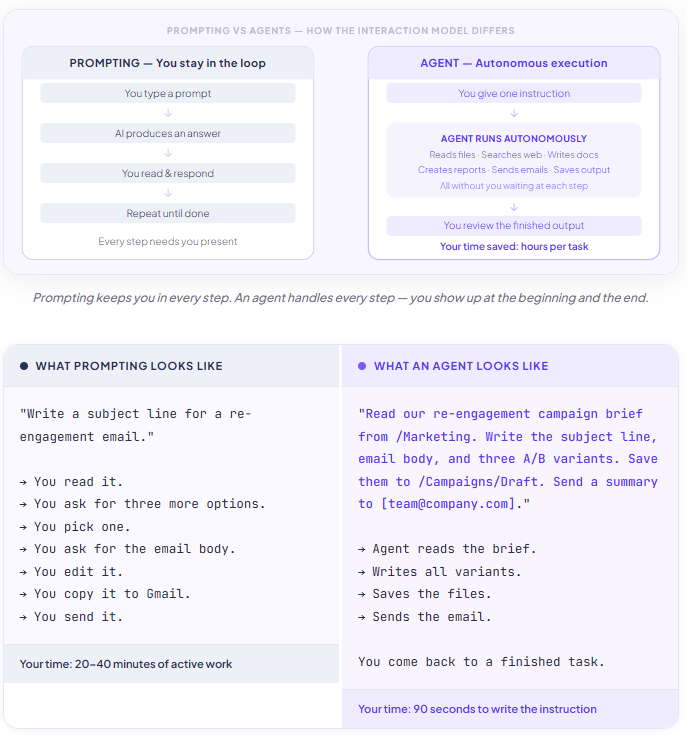
Think of prompting as having a conversation with a brilliant colleague. You ask, they answer, you react, they refine. Every step requires your involvement. It’s powerful — but you’re always in the loop, always the one moving the conversation forward.
Get Faheem Munshi’s stories in your inbox
Join Medium for free to get updates from this writer.
Remember me for faster sign in
An AI agent is different. You give it a task, a set of tools, and access to the resources it needs. Then it goes and does the work. It reads files. It writes documents. It searches the web. It sends emails. It organizes folders. It schedules reports. All without you hovering over it waiting for the next step.
The five things an agent can actually do
An AI agent is more capable than most people realise. Here’s what a modern agent — like Claude running in a desktop app with folder and connector access — can do right now, in 2026, without any coding required.
What an agent looks like in the real world
Theory is useful. But seeing it applied to actual work makes it click instantly. Here’s one real-world example of an AI agent completing a task that would normally take 45 minutes — in one instruction.
The anatomy of a good agent instruction
Prompting and agent instructions share a lot of DNA — but there are three extra elements that matter when you’re letting something run autonomously. Get these right and the agent works flawlessly. Miss them and it will either stop and ask you questions, or worse, guess.
Tomorrow, on Day 9, we look at Choosing Your AI Stack — how to match the right models, tools, and platforms to the specific tasks you want to automate, and what the 2026 landscape actually looks like when you cut through the noise.
Next up · Day 9 of 30: Choosing Your AI Stack: Models, Tools & Platforms in 2026
For more resourcces and documents, please refer to the links in my profile page: Faheem Munshi — Medium