
Business Intelligence Software Market Forecast: The Future of Data-Driven Business
In today's digital economy, data has become one of the most valuable assets for organizations. However, raw data alone holds little value unless it can be transformed into actionable insights. This is where Business Intelligence (BI) software plays a crucial role. By enabling companies to collect, analyze, visualize, and interpret vast amounts of information, BI platforms empower decision-makers to improve efficiency, reduce costs, and identify new growth opportunities.
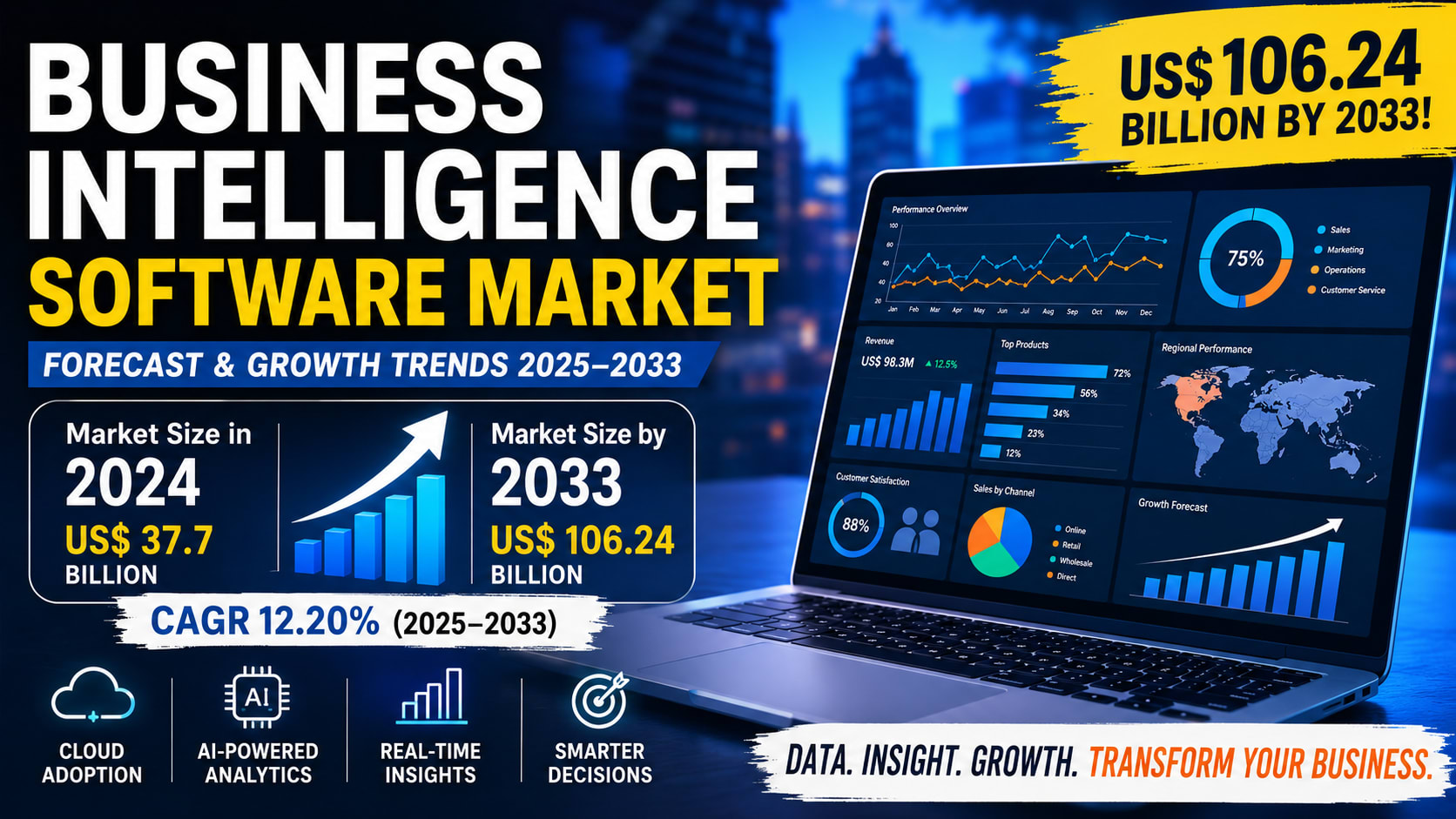
According to Renub Research, the global Business Intelligence Software Market was valued at US$ 37.7 Billion in 2024 and is projected to reach US$ 106.24 Billion by 2033, expanding at a remarkable CAGR of 12.20% during 2025–2033.
The rapid expansion of data generation, growing cloud adoption, and integration of artificial intelligence are creating a favorable environment for the widespread adoption of BI solutions across industries.
Understanding Business Intelligence Software
Business Intelligence software refers to a collection of technologies, applications, and processes designed to transform raw data into meaningful business insights. These platforms gather information from multiple sources, including databases, spreadsheets, enterprise applications, and cloud systems.
Modern BI solutions offer features such as:
Interactive dashboards
Real-time reporting
Data visualization
Predictive analytics
Data mining
Performance monitoring
AI-powered insights
Organizations use these tools to identify trends, monitor key performance indicators (KPIs), optimize operations, and improve strategic planning.
Popular BI platforms include Microsoft Power BI, Tableau, Qlik, Looker, SAP Analytics Cloud, and MicroStrategy.
Growing Demand for Data-Driven Decision Making
One of the most significant factors driving market growth is the increasing importance of data-driven decision-making.
Businesses today generate enormous volumes of data through customer interactions, online transactions, supply chains, IoT devices, and enterprise systems. Traditional reporting methods often fail to keep pace with this data explosion.
BI software enables organizations to:
Analyze large datasets quickly
Discover hidden patterns
Improve forecasting accuracy
Monitor operational performance
Enhance customer experiences
Companies that leverage data effectively gain a substantial competitive advantage by making faster and more informed decisions.
As organizations continue their digital transformation journeys, BI tools are becoming essential rather than optional.
Artificial Intelligence is Transforming Business Intelligence
Artificial Intelligence and Machine Learning are revolutionizing the BI landscape.
Traditional BI tools primarily focused on historical analysis. Modern AI-enabled platforms can now provide:
Predictive Analytics
Forecast future trends and business outcomes.
Prescriptive Analytics
Recommend specific actions to achieve business objectives.
Automated Insights
Identify trends and anomalies without manual intervention.
Natural Language Processing
Allow users to interact with data using conversational language.
AI-powered analytics significantly reduce the complexity of data interpretation and enable organizations to derive value from information much faster.
The combination of BI and AI is expected to become one of the strongest growth catalysts for the market throughout the forecast period.
Cloud-Based BI Solutions Gain Massive Popularity
Cloud computing has fundamentally changed how organizations deploy and manage Business Intelligence software.
Cloud BI platforms provide several advantages:
Lower infrastructure costs
Faster implementation
Improved scalability
Remote accessibility
Real-time collaboration
Automatic updates
Small and medium-sized enterprises (SMEs) are increasingly adopting cloud-based analytics because they eliminate the need for expensive on-premise infrastructure.
Additionally, cloud deployment enables organizations to scale resources according to changing business requirements, making it a highly attractive option in today's dynamic business environment.
As hybrid work models become more common, cloud BI adoption is expected to accelerate further.
Mobile Business Intelligence Enhances Workforce Productivity
The growing use of smartphones and tablets has led to the rapid emergence of mobile BI solutions.
Executives, managers, and field personnel increasingly require access to business insights while on the move.
Mobile BI platforms provide:
Real-time data access
Instant performance monitoring
Remote reporting capabilities
Faster response times
Improved operational agility
These capabilities are especially valuable in industries such as retail, logistics, healthcare, telecommunications, and financial services.
Although security concerns remain a challenge, advancements in mobile security technologies are helping organizations confidently adopt mobile analytics solutions.
Large Enterprises Continue to Lead Adoption
Large enterprises represent one of the biggest users of Business Intelligence software.
These organizations manage massive datasets generated across multiple departments, geographic regions, and business units.
Advanced BI solutions help large enterprises:
Improve strategic planning
Enhance operational efficiency
Reduce costs
Identify market opportunities
Optimize customer engagement
Features such as predictive analytics, custom dashboards, multi-source integration, and AI-driven insights are particularly valuable for large-scale organizations.
As enterprises increasingly prioritize digital transformation, investment in sophisticated BI infrastructure continues to grow.
IT and Telecom Sector Drives Significant Demand
The IT and telecommunications industry generates enormous volumes of structured and unstructured data daily.
Business Intelligence software enables telecom providers and technology companies to:
Monitor network performance
Predict outages
Analyze customer behavior
Improve service quality
Optimize marketing campaigns
Real-time analytics has become essential in this highly competitive sector where rapid decision-making directly impacts customer satisfaction and profitability.
As 5G networks, IoT ecosystems, and digital services expand globally, BI adoption within the IT and telecom sector is expected to remain strong.
Regional Market Analysis
United States
The United States remains one of the world's largest and most mature Business Intelligence markets.
Organizations across healthcare, finance, retail, manufacturing, and technology sectors are increasingly investing in advanced analytics platforms to improve decision-making and maintain competitive advantages.
Strong technology infrastructure, high cloud adoption, and the presence of major BI vendors continue to support market expansion.
France
France is witnessing steady growth in BI adoption due to ongoing digital transformation initiatives and increasing cloud migration.
French organizations are focusing on improving operational efficiency while maintaining compliance with strict data privacy regulations such as GDPR.
Demand for secure and scalable analytics solutions continues to rise throughout the country.
India
India has emerged as one of the fastest-growing Business Intelligence markets globally.
Factors driving growth include:
Rapid digitalization
Expanding SME sector
Increased cloud adoption
Government digital initiatives
Growing awareness of data-driven decision-making
Affordable cloud-based BI platforms are making advanced analytics accessible to businesses of all sizes.
Saudi Arabia
Saudi Arabia's Vision 2030 initiative is creating substantial opportunities for Business Intelligence vendors.
Organizations in sectors such as banking, healthcare, energy, and government services are increasingly investing in analytics solutions to support digital transformation goals.
The growing emphasis on smart cities and data-driven governance is expected to accelerate BI adoption across the Kingdom.
Challenges Facing the Business Intelligence Software Market
Despite strong growth prospects, several challenges remain.
Data Security and Privacy Concerns
Organizations handling sensitive information must comply with increasingly complex regulations.
Cybersecurity threats and potential data breaches remain major concerns when implementing BI systems.
High Implementation Costs
Although cloud solutions have reduced entry barriers, many organizations still face costs related to:
Software licensing
Integration
Employee training
Maintenance
Infrastructure upgrades
These challenges can slow adoption, particularly among smaller businesses with limited budgets.
Competitive Landscape
The Business Intelligence Software Market remains highly competitive, with leading technology companies investing heavily in AI, cloud analytics, and automation capabilities.
Major market participants include:
IBM Corporation
Microsoft
Oracle
Sisense Ltd
QlikTech International AB
SAP SE
Board International
MicroStrategy Incorporated
These companies continue to expand their product portfolios and strengthen their market positions through innovation, partnerships, and strategic acquisitions.
10 Recent Developments from Leading Companies
1. MicroStrategy (June 2024)
Introduced enhanced AI-powered data insights capabilities that can be embedded directly into web and mobile applications.
2. GoodData (November 2022)
Launched GoodData Cloud on AWS, offering scalable cloud-native analytics with API-first architecture.
3. Zoho Analytics (September 2024)
Released more than 100 enhancements, including advanced AI-driven predictive analytics and automated report generation.
4. HCLTech (July 2023)
Introduced HCLTech Advantage Analytics powered by Snowflake's Data Cloud and artificial intelligence technologies.
5. Informatica (April 2024)
Expanded its Intelligent Data Management Cloud platform in Saudi Arabia with a new Riyadh Point of Delivery.
6. Microsoft
Continued expanding Copilot AI capabilities across Power BI to improve natural language analytics and automated insights.
7. SAP
Enhanced SAP Analytics Cloud with stronger planning, forecasting, and AI-assisted business intelligence features.
8. Oracle
Expanded Oracle Analytics Cloud functionality through AI-powered predictive modeling and automated decision support.
9. Qlik
Strengthened its analytics portfolio with augmented intelligence capabilities that automate data discovery processes.
10. IBM
Expanded Watson-powered analytics solutions focused on enterprise automation and intelligent business insights.
Final Thoughts
The global Business Intelligence Software Market is entering a transformative phase fueled by artificial intelligence, cloud computing, and the growing need for real-time decision-making.
As organizations continue to generate unprecedented amounts of data, the ability to convert information into actionable insights will become increasingly critical. Business Intelligence platforms are evolving from simple reporting tools into sophisticated decision-support systems capable of predicting trends, automating analysis, and guiding strategic actions.
With the market expected to grow from US$ 37.7 Billion in 2024 to US$ 106.24 Billion by 2033, businesses that invest in advanced analytics capabilities today will be better positioned to compete in tomorrow's data-driven economy.