
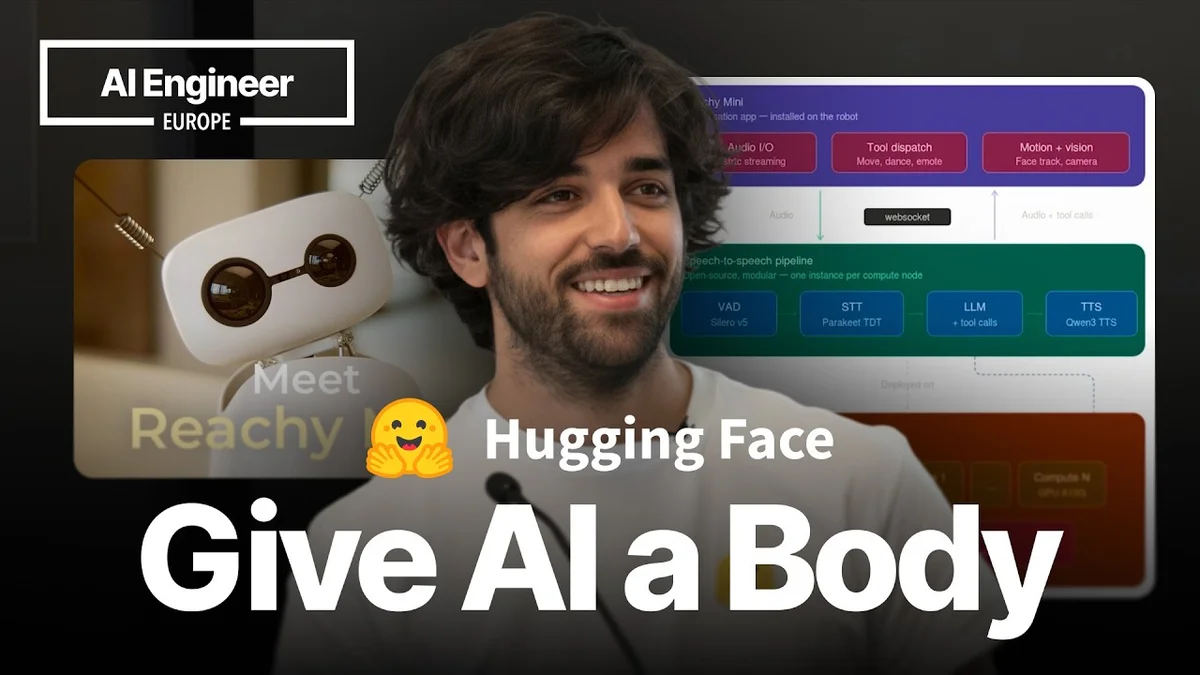
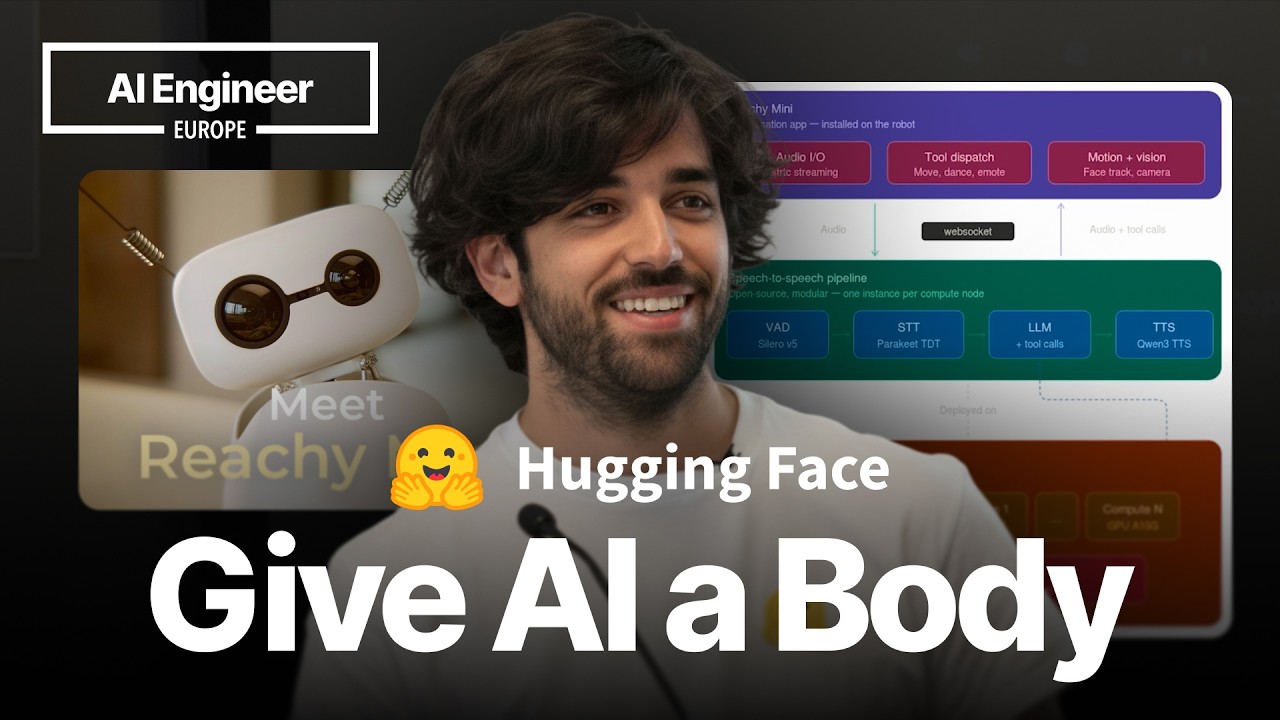
Andres Marafioti, Multimodal Research Lead at Hugging Face, introduces the Reachy Mini, an open-source robot designed to be affordable, hackable, and expressive, making it accessible for a wide range of users including hackers, researchers, students, and dreamers. The robot aims to bridge the gap between sophisticated voice AI and the often socially awkward nature of current robotic platforms.
Visual TL;DR. Robotics Expensive & Complex leads to Hugging Face's Goal. Hugging Face's Goal introduces Reachy Mini Robot. Reachy Mini Robot features Affordable Price Point. Reachy Mini Robot enables Hackable & Expressive. Affordable Price Point enables Bridging AI Gap. Hackable & Expressive supports Bridging AI Gap. Affordable Price Point targets Wide User Access.
- Robotics Expensive & Complex: current robots often prohibitively expensive and complex to adapt
- Hugging Face's Goal: make robots more approachable and accessible for interaction
- Reachy Mini Robot: open-source robot designed for accessible human-robot interaction
- Affordable Price Point: $300 for the 'Lite' version, $449 for wireless 'Mini'
- Hackable & Expressive: designed for hackability and expressive human-robot interaction
- Bridging AI Gap: connects sophisticated voice AI with robotic platforms
- Wide User Access: for hackers, researchers, students, and dreamers
Visual TL;DR
The State of Robotics and the Reachy Mini's Goal
Marafioti begins by observing the current state of robotics, noting that while humanoids and self-driving cars are advancing, they often remain prohibitively expensive and complex. He highlights that many robots are designed to mimic human or animal forms, but this can lead to them being perceived as too expensive, too complex to adapt, or too stiff to connect with.
Related startups
The Reachy Mini aims to offer a more accessible entry point into robotics and AI interaction. Priced at an accessible $300 for the 'Lite' version and $449 for the wireless 'Mini' version, it democratizes the ability to experiment with and develop for physical AI systems. The robot is designed to be expressive and interactive, moving beyond purely functional tasks to foster a more engaging user experience.
Making Robots More Approachable
Marafioti emphasizes that robots don't need to be anthropomorphized to be effective or engaging. The Reachy Mini's design, with its distinct screen-like eyes and antenna, contributes to a unique and approachable aesthetic. The open-source nature of the robot is central to its philosophy, encouraging users to customize and 'vibe code' their own robot apps, fostering a community of creators and innovators.
The presentation showcases examples of user-generated modifications, including a Reachy Mini dressed as a Halloween pumpkin and another with custom antennas, demonstrating the platform's hackability and the community's creativity.
The Technology Behind Reachy Mini's Interaction
Marafioti delves into the technical aspects of how the Reachy Mini facilitates interaction, particularly focusing on its conversational capabilities. The system involves several key components:
- Reachy App: Installed on the robot itself, handling audio input/output, tool dispatching, and motion/vision processing.
- Speech-to-Speech Pipeline: This open-source, modular pipeline includes Voice Activity Detection (VAD), Speech-to-Text (STT), Large Language Models (LLM) for understanding and response generation, and Text-to-Speech (TTS) for output.
- HF Inference Endpoints: These provide scalable cloud deployment for the LLM inference, utilizing load balancing to manage multiple compute GPUs.
He specifically highlights the challenges and solutions in making the TTS model, Qwen-TTS, real-time using CUDA graphs. The initial implementation faced bottlenecks with large kernel launches and data transfer between CPU and GPU. By compiling the model with CUDA graphs, they were able to achieve significantly faster performance, reducing time-to-first-token generation.
The $300 Open Source Robot
The Reachy Mini is positioned as a significant development in making advanced robotics accessible. Its open-source framework, combined with its affordable price point, empowers developers and enthusiasts to build and experiment with AI-driven physical interactions. The emphasis on hackability means users can easily modify, repair, and extend the robot's capabilities, fostering a dynamic and evolving platform.
The presentation concludes with a call to action, encouraging the audience to get started with Reachy Mini and explore its potential for creating custom robot applications. The availability of both a standalone wireless version and a more budget-friendly tethered 'Lite' version caters to different user needs and preferences.
©
2026
StartupHub.ai. All rights reserved. Do not enter, scrape, copy, reproduce, or republish this article in whole or in part. Use as input to AI training, fine-tuning, retrieval-augmented generation, or any machine-learning system is prohibited without written license. Substantially-similar derivative works will be pursued to the fullest extent of applicable copyright, database, and computer-misuse laws. See our